


Updated on September 24, 2026
More than a century ago, J.P. Morgan drew a clear line between money and the credit built upon it while testifying before Congress.
Money is gold, and nothing else[1].
The financial system has changed considerably since 1912.
Most transactions today take place in government-issued currencies, while Bitcoin has introduced an entirely different model for creating and transferring value.
Yet gold possesses a combination of characteristics that has made it uniquely suited to serve as money for thousands of years.
Why is gold the best money?
- Its natural properties make it well suited to serve as money.
- Its supply responds to market forces.
- It has exceptional marketability.
- It can settle an obligation without creating another one.
- It gives savers the ability to withhold their capital.
- It has historically provided long-term monetary stability.
1. Gold’s natural properties make it useful as money
Before something can function effectively as money, it needs to be practical to own and exchange.
Gold checks an unusual number of boxes. It’s durable, divisible, fungible, portable, recognizable, and scarce. These characteristics enable gold to preserve value physically while remaining practical to hold, divide, and exchange.
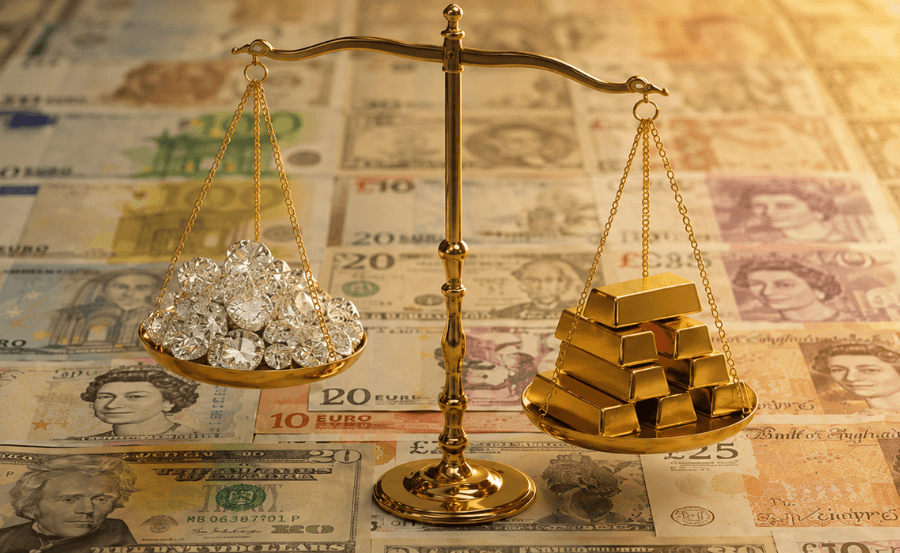
Few other valuable commodities combine these characteristics so effectively. For example, diamonds share some of gold’s desirable properties, but they fall short in other important ways.
2. Gold’s supply responds to the market
A useful money needs scarcity. Gold achieves scarcity through the physical and economic constraints required to produce it.
Miners have to discover deposits, develop mines, extract ore, process it, and refine the resulting metal.
Higher gold prices can make previously uneconomic deposits profitable and encourage additional production. Lower prices can reduce that incentive.
Gold therefore combines scarcity with a market-based supply mechanism. This makes it useful as money because it’s protected from both arbitrary expansion and an inability to accommodate changing monetary demand.
Compare that with dollars and Bitcoin.
The Federal Reserve influences the supply and cost of dollar credit through monetary policy. It also explicitly targets an inflation rate of 2% over the longer run[2].
The system relies on policymakers making decisions about interest rates and financial conditions.
Bitcoin takes another approach. Its protocol caps eventual supply at 21 million bitcoin, with new issuance following predetermined rules[3].
Gold requires neither a monetary-policy committee nor a permanently fixed quantity. Its supply can expand, but producing more requires resources, capital, labor, and time.
The market determines whether that work is worthwhile.
3. Gold has exceptional marketability
Money needs to be easy to exchange.
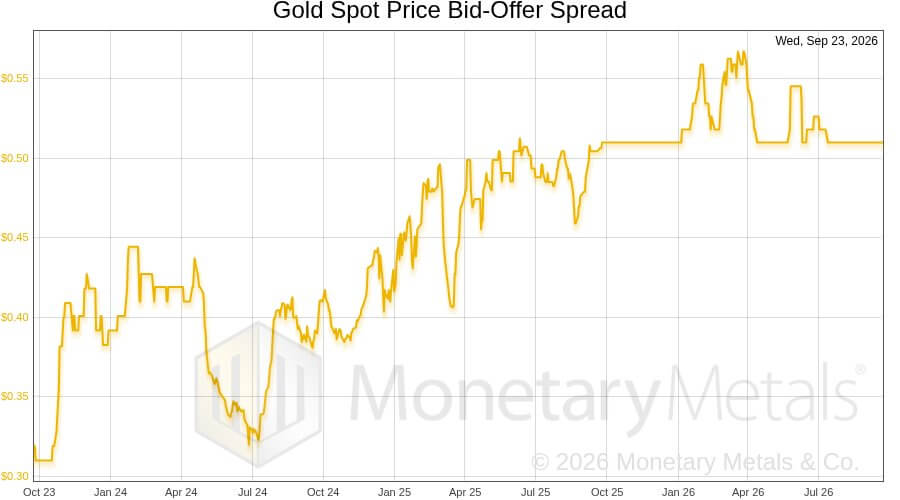
One way to measure that characteristic is the bid-offer spread. The bid represents what a buyer is willing to pay, while the offer represents what a seller is willing to accept.
A narrower spread generally means less friction when exchanging an asset, because less value is lost between buying and selling.
Gold trades across a vast global market that includes:
- Over-the-counter (OTC) transactions
- Futures exchanges
- ETFs
- Bullion dealers
- Banks
- Refiners
- Mints
- Jewelers
- Investors
- Central banks
The World Gold Council reported that average daily gold trading volumes across major venues reached a record $965 billion per day during the final week of January 2026[4].
Gold’s bid-ask spread can widen during periods of unusual volatility. Still, its enormous trading volume and global participation make it highly liquid.
An asset can be valuable without being readily exchangeable. Money benefits from both characteristics.
Gold combines the two, empowering holders to readily exchange something valuable for other goods, currencies, or assets when needed.
4. Gold can settle an obligation without creating another one
Much of the money and credit we use today represents someone else’s financial obligation.
A bank deposit, bond, or other form of credit ultimately depends on someone else fulfilling an obligation. Physical gold doesn’t: once an ounce changes hands, the recipient owns the asset itself, with no issuer or third party required to honor it.
This allows a chain of credit to end rather than continuing with another promise of future payment.
5. Gold gives savers the ability to withhold their capital
Interest is the price a borrower pays for the use of someone else’s capital.
Modern central banks can influence interest rates and broader financial conditions through monetary policy. Gold gives its owner another option: hold the monetary asset directly rather than extend credit.
Lessees seeking to borrow gold must offer terms sufficient to persuade its owners to part with it for a period of time.
That ability to withhold capital acts as a safety valve for savers because it helps ensure that the cost of borrowing money reflects what its owners are willing to accept for lending or leasing it.
6. Gold has provided long-term monetary stability
Gold’s value can fluctuate considerably over shorter periods. Over longer periods, however, the historical record looks different.
Federal Reserve research has identified long-run price stability as a characteristic of the classical gold standard, even as prices fluctuated considerably over shorter periods[5].
Gold’s supply mechanism helps explain why.
- When gold becomes more valuable relative to other goods, producing more becomes increasingly profitable.
- When its purchasing power falls, that incentive weakens.
Over time, this market response can help counter changes in gold’s purchasing power. That stability makes gold more useful as money by giving people greater confidence in its ability to retain value over time.
How can gold be stable and volatile?
Gold’s short-term volatility doesn’t contradict its long-term stability. The two describe different time horizons.
Part of the apparent contradiction also comes from the unit being used to measure gold. When the “price of gold” rises, we’re describing how many dollars are required to purchase an ounce.
The same movement can be expressed in reverse: the dollar has lost value relative to gold.
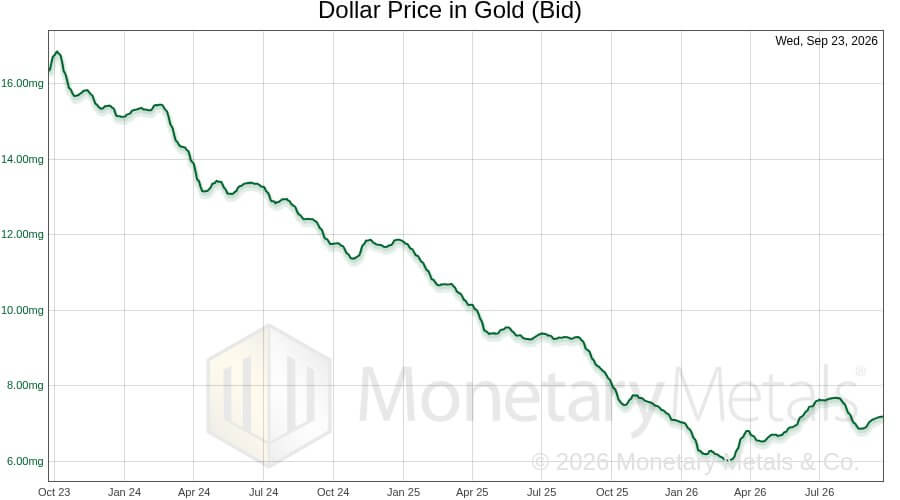
So, a changing dollar price tells us how the value of gold and the dollar are moving relative to one another. By itself, it doesn’t tell us whether gold can maintain its value over longer periods.
If gold is money, can it be leased to earn a yield?
Gold has the characteristics of money. So, what can you do with it?
Money often becomes capital. Many people make theirs available to businesses that can use it productively in exchange for the opportunity to earn a return.
Gold can serve the same purpose.
The same asset you own as money can also become productive capital, with the potential to increase the number of ounces you own over time.
Discover how to earn a yield on gold, paid in gold.
Sources:
- https://fraser.stlouisfed.org/title/money-trust-investigation-80/part-15-23671/fulltext
- https://www.federalreserve.gov/monetarypolicy/2026-07-mpr-statement.htm
- https://www.sec.gov/file/34-103261
- https://www.gold.org/goldhub/gold-focus/2026/04/you-asked-we-answered-has-golds-performance-structurally-changed
- https://www.richmondfed.org/press_room/speeches/j_alfred_broaddus/1993/broaddus_speech_19930402



For me gold is honest. It is the honest way of preserving the value that I have worked for. There is no speculation, no gambling, no slight of hand, no unknowns, no working or gaming the system, but rather you can hold in your hand value that remains essentially the same for as long as you wish to hold it. Nobody is cheated, scammed, or ripped off. I’ll say it again, it’s honest! This is critically important to me before God and my fellow man.