
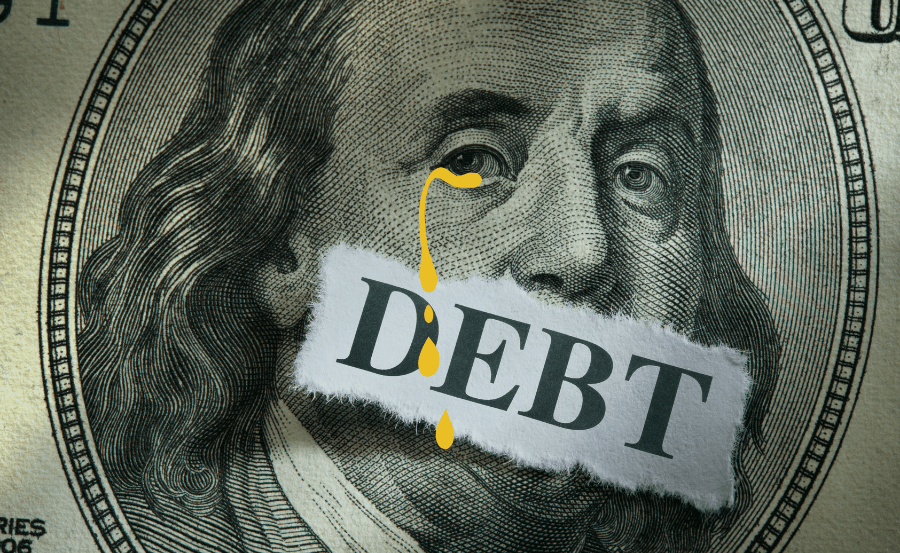

Gross federal debt has crossed $40 trillion for the first time in 250 years.
Most coverage of that milestone follows a familiar script: more debt means more inflation, and more inflation means higher gold prices.
It’s a tidy story, and it isn’t wrong so much as incomplete. Debt and gold have moved together for long stretches of history and diverged sharply during others.
The relationship deserves more scrutiny than a chart with two rising lines usually gets.
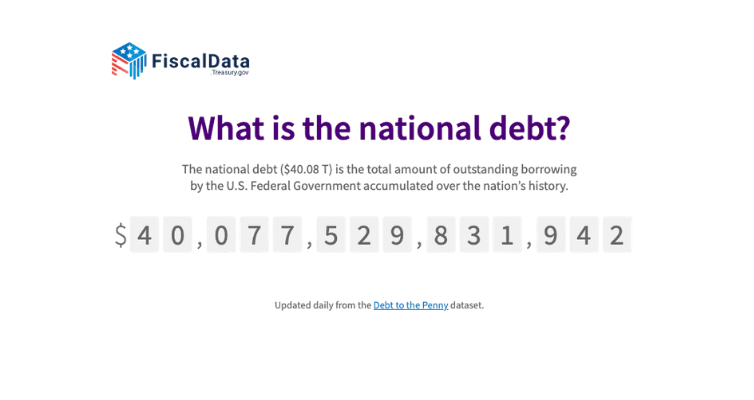
What does $40 trillion debt mean?
A $40 trillion debt means that the U.S. government has borrowed that amount by issuing Treasury securities, and is legally obligated to repay it with interest.
This represents two sides of one coin: an asset and a liability.
For an investor holding a Treasury security, it’s an asset: a promise they’ll earn interest and eventually recover the principal. For the Treasury, it’s a liability: an obligation to deliver dollars at a specified point in the future.
The value of that promise depends in part on two things:
- whether the government can honor its obligations
- what those dollars will be worth when they’re received
The record level of federal debt is one factor contributing to investors’ demands for greater compensation to hold long-dated government debt. In August 2026, the Treasury sold new 30-year bonds at a yield of 5.2%, the highest auction yield since 2001[2].
Who is owed the U.S. national debt?
About $32.3 trillion is debt held by the public[3] in Treasury bonds, notes, and bills owned by:
- individuals
- pension funds
- mutual funds
- foreign governments
- other outside investors
The remaining $7.8 trillion is intragovernmental debt [3]: money the Treasury owes to other parts of the federal government, largely the Social Security and Medicare trust funds.
Does another record debt level guarantee a crisis?
No. On its own, $40 trillion doesn’t indicate that default, hyperinflation, or a dollar collapse is imminent.
Economists don’t have a reliable, universally agreed-upon line at which sovereign debt automatically becomes unsustainable. What matters is more context:
- debt relative to the size of the economy
- the cost of servicing it
- the maturity structure of what is outstanding
- investor appetite for buying more of it
- inflation
- economic growth
- the fiscal and monetary choices policymakers make along the way
What does $40 trillion mean for gold owners?
For gold owners, the significance isn’t simply that federal debt has crossed $40 trillion.
It’s that a growing stock of government obligations can increase concerns about fiscal sustainability, future inflation, and the purchasing power of the dollars in which those obligations are paid.
Increased fiscal stress has been associated with stronger gold demand, even after accounting for the dollar and real interest rates separately[4].
Does rising national debt make gold more valuable automatically?
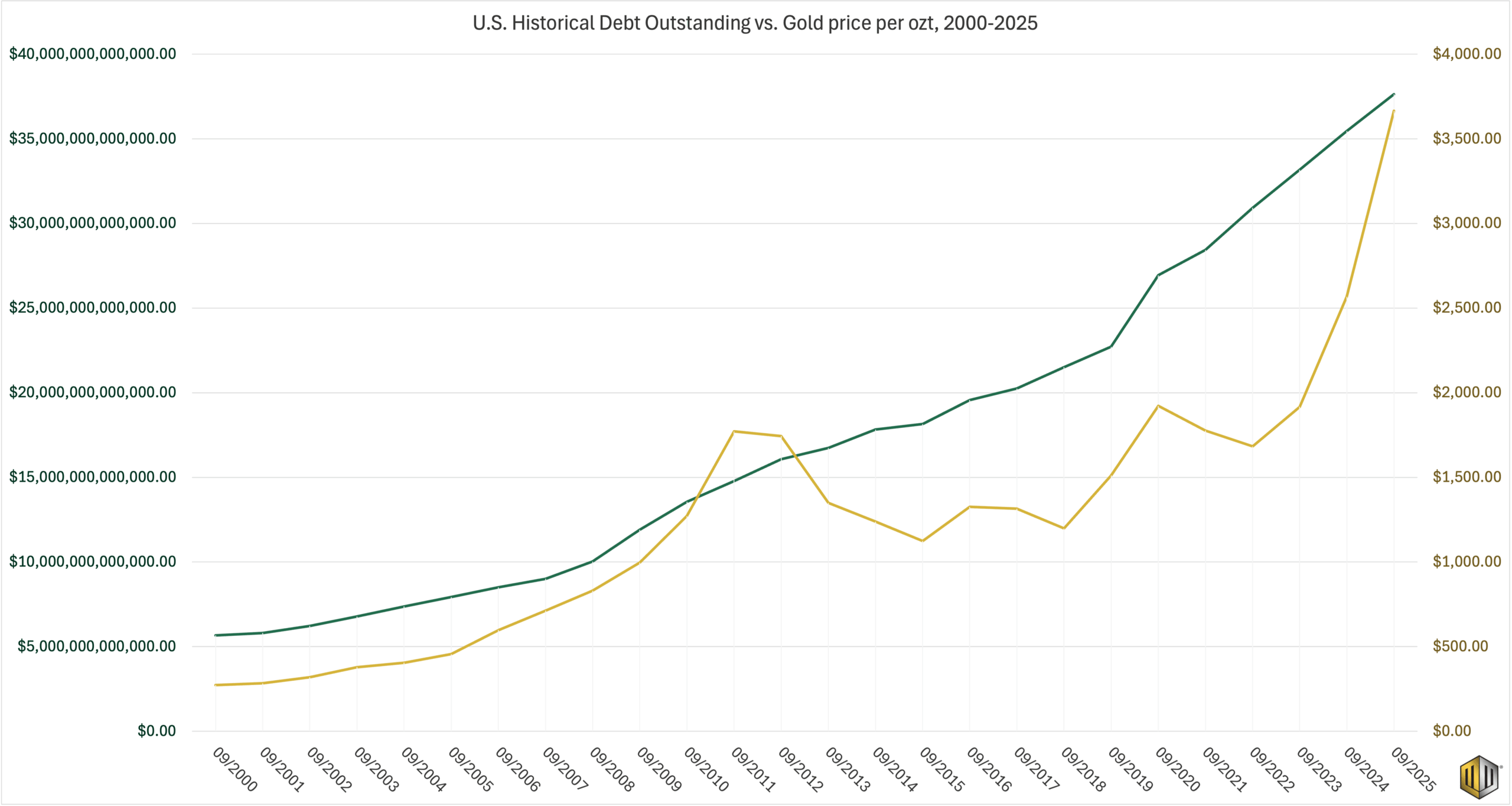
No, rising national debt doesn’t make gold more valuable automatically. Debt and gold have trended upward together over long stretches of history, but the relationship isn’t mechanical.
Debt levels alone don’t set the gold price. National debt kept climbing after 2012, for instance, while gold fell substantially over the years that followed.
Gold responds to a wider set of forces, including:
- real interest rates
- the strength of the dollar
- investment and jewelry demand
- central bank buying
- inflation expectations
- geopolitical tension
- broader confidence in financial assets
Rising debt is one input among several, not a dial that moves the gold price on its own, but it does increase the relevance of an asset that’s nobody else’s liability.
The value of gold doesn’t come from liability.
Every Treasury security represents an asset to its owner and a corresponding obligation of the U.S. government.
Gold works differently.
An ounce of gold has no issuer, no borrower who must remain solvent, no maturity date, and no promise that must be honored.
Unlike financial assets, gold is a real asset: it has no credit or counterparty risk…[7]
It’s worth noting that gold is not risk-free. Its market price moves, and at times, sharply.
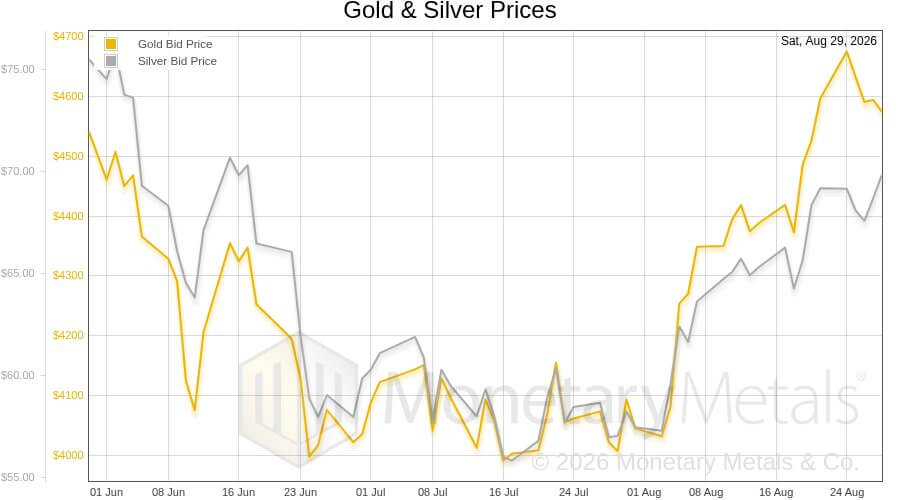
And how you hold your gold can also introduce risk. For example, if you store your gold in a professional vault, there could be a hidden cost to a rising gold price.
What gold lacks specifically is the credit and counterparty risk embedded in every promise-based financial asset. This is a property that’s unique to gold as an asset.
Traditionally, gold’s independence comes with a tradeoff
Gold’s structural advantage hasn’t made it the obvious choice for every investor at every moment, and there’s a reason for that.
The same feature that removes counterparty risk also removes income.
- A Treasury security pays interest because the government borrows an investor’s money.
- A bank deposit can earn interest because the bank puts deposited funds to work.
- A dividend-paying stock can provide income when a company distributes a portion of its earnings to shareholders.
Physical gold operates differently. Nobody owes its owner anything simply for holding it.
There’s no contractual relationship generating a payment, because there’s no contract at all. Gold’s independence and its traditional lack of yield are two expressions of the same underlying fact: gold is nobody’s liability.
Can gold remain independent but be deployed productively?
Yes, gold can remain independent while it’s used productively.
After all, gold’s lack of an issuer is a property of the metal itself; it doesn’t disappear simply because you decide to do something with it.
Consider gold leasing.
Businesses that use gold as an input need physical supply to operate. You can lease gold to those businesses in exchange for a return, much like a landlord earning rent on their property.
(Review our Funded deals to explore businesses that use leased gold.)
But it’s worth noting what changes when that happens. Gold leasing is a contract, and contracts create counterparty exposure.
Once you lease your gold to a business, you rely on that business to meet its obligations in much the same way a bondholder relies on an issuer to meet its own.
To minimize that risk, companies like Monetary Metals observe strict procedures to protect their clients’ gold and silver.
Why would a gold owner reintroduce counterparty risk?
- To offset the costs of holding gold: generating a yield can offset storage and insurance costs.
- To mitigate opportunity costs: by leasing their metal, gold owners can generate a yield rather than relying exclusively on other assets for portfolio income.
- To generate income in a real asset: earning a yield in gold ounces compounds a gold position without requiring the gold price to rise.
Gold gives you a choice that $40 trillion of debt can’t
$40 trillion isn’t a forecast, it’s a snapshot of how much of modern financial wealth is built on interlocking promises. It also shows how large that structure has grown.
Gold sits outside that structure. Its existence and value don’t depend on anyone else’s promise being kept. It doesn’t require predicting a crisis, and it doesn’t rest on one occurring.
What it offers instead is a genuine choice: should you hold gold in its non-yielding form, paying to store and insure it (or accepting the risks to store it at home)?
Or should you accept a degree of counterparty risk to earn more of that money?
Yes, that means deliberately introducing an economic relationship where, by gold’s nature, none exists by default. But doing so may empower you to grow wealth in a real asset.
Discover whether putting your gold to work is right for you.
Sources:
- https://fiscaldata.treasury.gov/americas-finance-guide/national-debt/
- https://finance.yahoo.com/economy/policy/articles/us-set-pay-most-30-080000426.html
- https://www.crfb.org/papers/qa-gross-debt-versus-debt-held-public
- https://www.gold.org/goldhub/gold-focus/2025/06/you-asked-we-answered-are-fiscal-concerns-driving-gold
- https://fiscaldata.treasury.gov/datasets/historical-debt-outstanding/historical-debt-outstanding
- https://www.gold.org/goldhub/data/gold-prices
- https://www.gold.org/goldhub/research/investment-update-gold-efficient-hedge