


Warren Buffett’s case against gold has endured because it identifies a genuine weakness: traditional gold ownership generates no income and adds no ounces to an investor’s holdings.
However, a sound argument can become incomplete when one of its underlying assumptions changes. For the past 10 years, gold owners have earned yields by making their metal available to businesses that use it productively.
The results don’t merely invite another debate over whether gold’s price has beaten the stock market. They challenge the premise at the heart of Buffett’s criticism.
Gold itself hasn’t changed, but what investors can do with it has.
Does Buffett’s argument hold when gold becomes productive?
What has Warren Buffett said about gold?
Warren Buffett has consistently described gold as an unproductive asset. It doesn’t generate earnings, pay dividends, create goods, or produce additional ounces.
Any return depends on someone eventually paying a higher price for it.
In Berkshire Hathaway’s 2011 shareholder letter[1], Buffett illustrated this criticism by imagining the world’s entire gold supply melted into a giant cube. A century later, he argued, the cube would remain unchanged.
Meanwhile, an equivalent investment in farmland and businesses could produce crops, earnings, and dividends throughout that period.
“…if you own one ounce of gold for eternity, you’ll still own one ounce at the end.”
Buffett did acknowledge that gold’s dollar price can rise. But his argument is about what must happen for an investment to create lasting value.
And why he believes gold fails that test.
Why doesn’t Warren Buffett invest in gold?
Warren Buffett has historically avoided gold because (traditionally):
- It produces no earnings or cash flow. A bar sitting in a vault doesn’t manufacture products, serve customers, or generate revenue.
- It doesn’t create additional ounces. Conventionally held gold can’t compound in quantity because it produces no additional ounces.
- Its returns depend on future buyers paying a higher price. To realize a capital gain, the owner must sell into a market willing to value the metal more highly than when it was purchased.
- Fear and rising prices can fuel speculative demand. A legitimate concern about currency depreciation can become a self-reinforcing cycle when price gains attract buyers who treat those gains as evidence that prices will continue rising.
- It forgoes the returns that productive assets could generate. Every dollar committed to gold is a dollar that can’t purchase a productive asset, while storage and insurance fees can reduce holdings or returns.
Buffett is right about traditional gold ownership.
A bar stored in a vault doesn’t produce cash flow.
It doesn’t create additional ounces.
Its dollar appreciation depends on demand, and holding it carries an opportunity cost.
But this critique isn’t as strong today as it may have been 25 years ago.
Can gold become a productive asset?
Yes, gold can—and has—become a productive asset.
While the world’s most famous investor is quick to point out that gold can’t produce anything by itself, he seems to miss the obvious: neither can a building, a machine, or a piece of farmland when nobody puts it to use.
An asset becomes economically productive when someone deploys it for a productive purpose. Gold leasing is the mechanism by which businesses throughout the precious metals industry deploy gold for a productive purpose.
- Jewelers require it for inventory and manufacturing.
- Mints need metal to produce coins and bars.
- Refiners and other firms may hold gold as work in progress while transforming it into another marketable form.
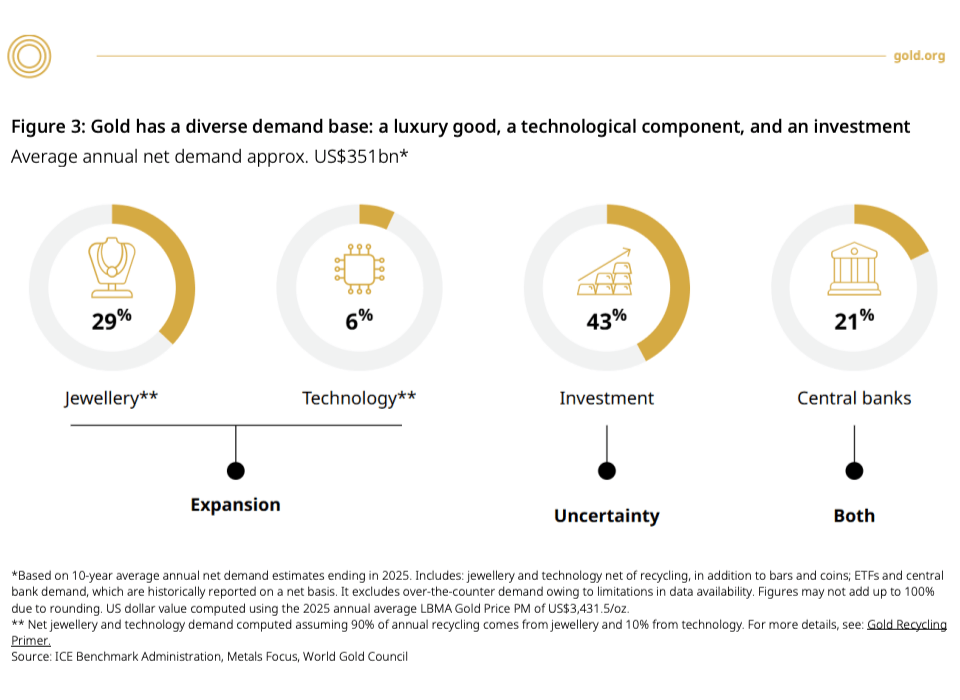
These businesses can purchase the gold with their own capital, borrow dollars to finance it, or lease the metal from an existing owner.
And for the past 10 years, gold-using businesses have been doing just that.
A decade of lease data challenges the “gold is unproductive” myth
Since 2016, businesses have paid consistently to lease physical gold, and not in dollars, but in additional ounces. Average annualized lease yields remained near 3% for much of the decade before approaching 4% in 2026.
Historical gold lease rates, 2016-2026
| Yield | Average annualized lease yield |
|---|---|
| 2016 | 3.00% |
| 2017 | 3.19% |
| 2018 | 2.82% |
| 2019 | 2.81% |
| 2020 | 2.94% |
| 2021 | 2.81% |
| 2022 | 2.34% |
| 2023 | 2.52% |
| 2024 | 3.09% |
| 2025 | 3.16% |
| 2026 | 3.91% |
| 2027* | 4.00% |
| Average | 3.05% |
This record demonstrates that gold leasing wasn’t a temporary response to a single set of market conditions. Instead, it reveals a durable financing relationship between gold-using businesses and owners willing to supply the metal.
Like rent on a building or interest on borrowed capital, the yield didn’t originate from the asset itself. It came from businesses using the asset to support productive activity.
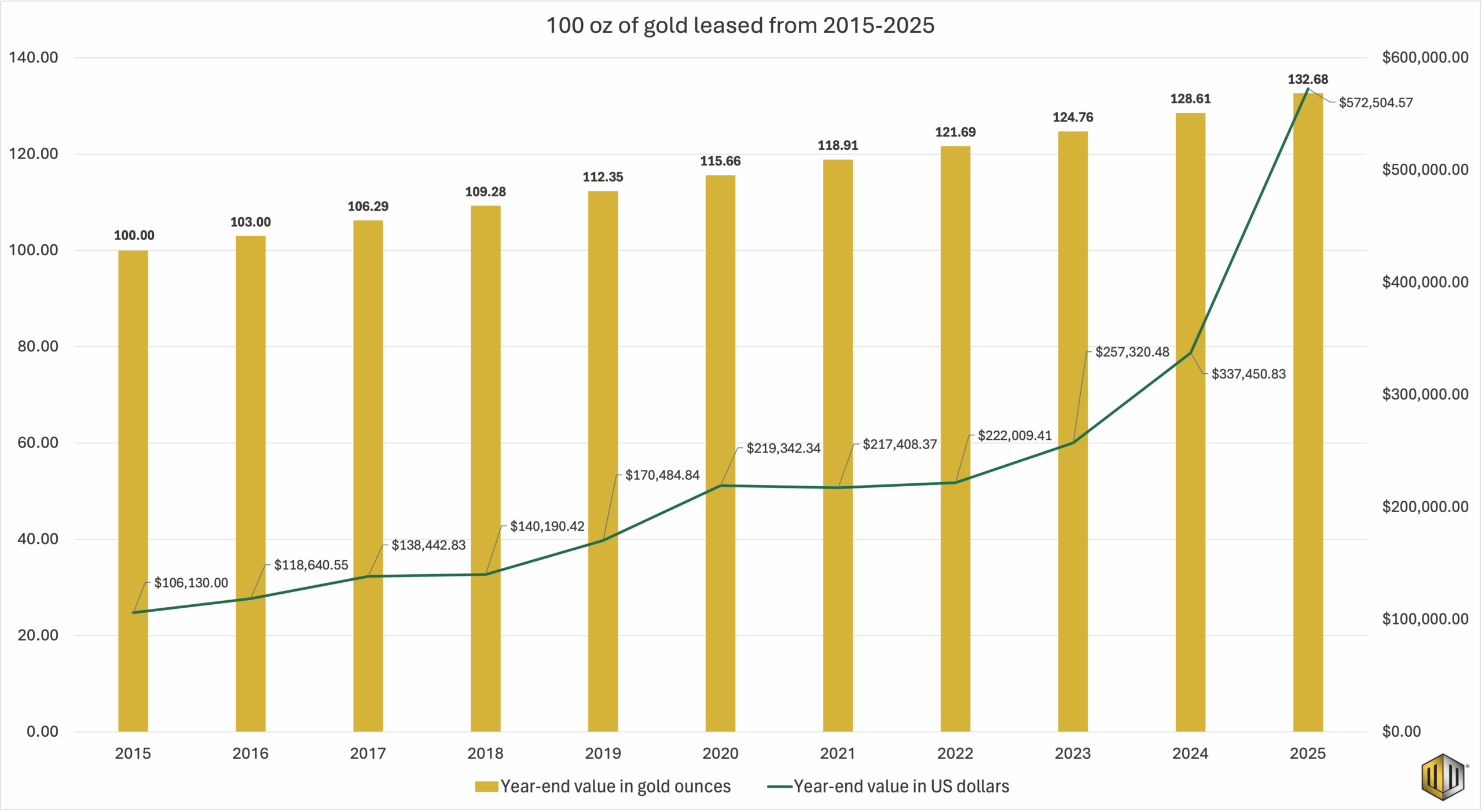
100 ounces compounding at historical average annual lease yields would’ve grown to 132.68 ounces by the end of 2025, worth about $572,505 at the year-end gold price.
The result challenges Buffett’s assumptions directly:
- Gold leasing produces earnings in money (additional gold), paid by businesses that use the metal to manufacture products, serve customers, and generate revenue.
- It creates additional ounces, which can compound in quantity over time.
- It generates returns through lease payments rather than depending on a future sale at a higher price.
- It generates returns from businesses’ productive demand for gold, not speculative demand fueled by fear or rising prices.
- It reduces the opportunity cost of holding gold by adding a source of return, eliminating storage fees, and minimizing insurance fees.
Taken together, these results turn Buffett’s universal criticism of gold into a narrower observation about idle gold. The question for gold owners is no longer whether their metal can generate a return, but whether they want to put it to work.
How do you put your idle gold to work?
Businesses have repeatedly found productive uses for gold, and have paid its owners for access to it.
In fact, the average annual lease yield for 2027 is projected to reach 4%. If achieved, it would be the fifth consecutive year in which the average rate has increased!
This demonstrates that the potential for gold owners to turn their metal holding into a productive asset is real and apparent. If you own gold, you owe it to your portfolio to determine whether productive gold serves your goals.
Discover how to earn more ounces with the ounces you already own at Monetary Metals.