

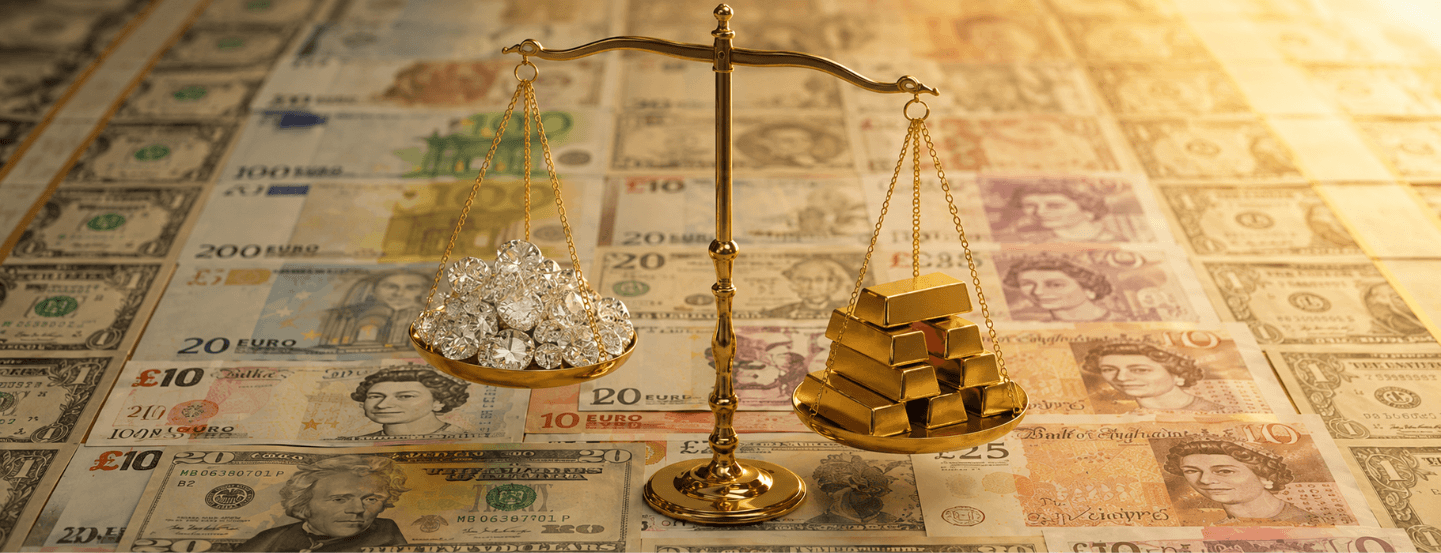

Diamonds seem like they should make excellent money: they’re scarce, durable, portable, and widely recognized as valuable.
In fact, they’re among the most desirable objects on Earth.
So why did civilizations throughout history independently choose gold as money instead?
Gold possesses a unique combination of characteristics that make it exceptionally well suited to serve as money. Diamonds, despite their desirability, lack several of those same qualities.
These differences help explain why gold has remained a monetary asset throughout history—and why that should still matter to gold owners today.
What makes something valuable as money?
Money must be practical to exchange, easy to value, difficult to create, and widely accepted by others, among other factors.
Throughout history, societies experimented with many forms of money[1], including shells, livestock, silver, paper, and even large stone disks[2].
Over time, gold emerged because it satisfies these requirements better than almost any other physical asset.
Diamonds share some of gold’s characteristics (including scarcity and durability) but they fall short in several areas that are essential for money.
Why did gold become money instead of diamonds?
Gold became money because it possesses the 7 characteristics of money:
- Fungibility and uniformity
- Recognizability
- Value stability
- Scarcity
- Durability
- Portability
- Divisibility
Diamonds became a commodity because they don’t possess all 7 characteristics.
Fungibility + uniformity + recognizability: Gold is standardized.
Money only works if people can quickly recognize and agree on what they’re exchanging.
Gold is highly standardized.
- A one-ounce bar of .9999 fine gold is interchangeable with any other bar of the same weight and purity.
- Once its authenticity has been verified, buyers and sellers don’t need to negotiate its quality every time it changes hands.
Every diamond is unique.
- Even seemingly similar stones can differ in one or more of the “5 Cs”: cut, clarity, color, carat, and certification.
Because every diamond must be evaluated individually, it can’t circulate as money in the same way standardized gold can.
Stability: Gold retains its value.
More than merely facilitating transactions, money should enable people to save purchasing power.
Gold has repeatedly fulfilled that role throughout history because its value isn’t tied to the policies or financial health of any government or company.
Diamonds can certainly be valuable. However, their value depends far more on the characteristics of each individual stone and the demand for particular sizes, cuts, and qualities.
As a result, gold has historically provided a more consistent monetary benchmark, while every diamond must be valued individually on its own merits.
If gold retains its value, why is its dollar price so volatile?
At first glance, this seems like a contradiction: if gold is a stable form of money, why does its dollar price sometimes rise or fall dramatically?
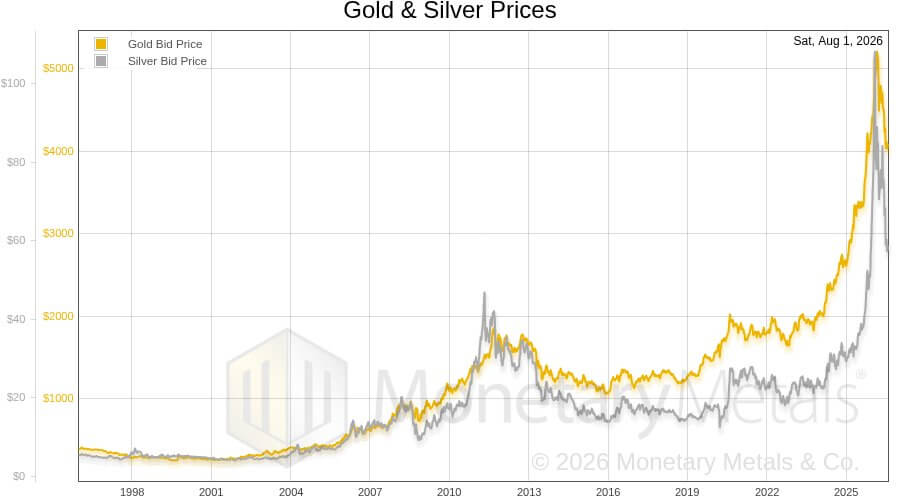
Part of the answer lies in how we measure it.
- Most people think of gold as something priced in dollars, but you can just as easily think of the dollar as something priced in gold.
- When the price of gold rises from $2,000 to $4,000 per ounce, it’s equally true that one dollar buys half as much gold as it did before.
In other words, the number changing on the price chart doesn’t necessarily mean gold itself has become more valuable. It may instead reflect a change in the purchasing power of the currency being used to measure it.
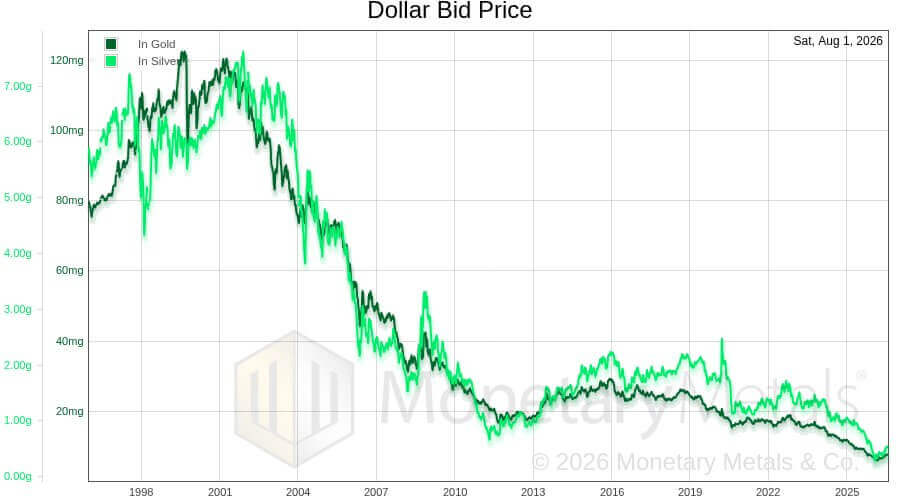
That’s why many gold owners pay attention to more than its dollar price.
They also consider what an ounce of gold can buy over long periods of time.
Although currencies have come and gone throughout history, gold has repeatedly demonstrated an ability to preserve purchasing power across generations.
(To explore this further, see “What crisis? Things are more affordable when priced in gold.”)
This perspective doesn’t mean gold’s quoted price won’t fluctuate, but it does mean that currencies themselves are constantly changing in value.
This makes them an imperfect yardstick for measuring a long-term monetary asset.
Scarcity: Gold is difficult to create.
A good form of money can’t be produced quickly or in unlimited quantities.
Gold’s supply grows slowly because new metal must be discovered, permitted, mined, refined, and brought to market—a process that often takes years or even decades.
Economists often describe this using the stock-to-flow ratio: the amount of an asset that already exists compared with the amount of new supply produced each year.
Gold has one of the highest stock-to-flow ratios of any widely traded commodity.
- Nearly all of the gold ever mined throughout history still exists in some form today.
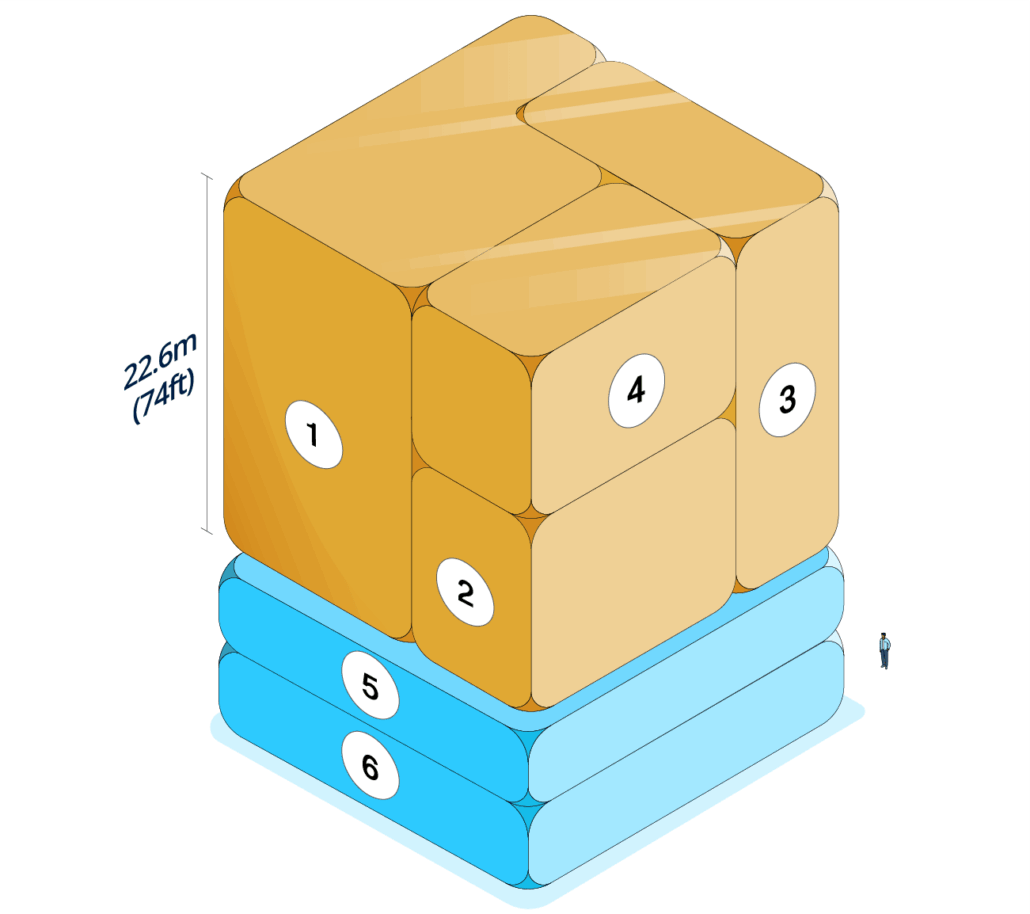
- Jewelry: ~99,700t, 45%, US$13.0tn
- Central banks: ~39,000t, 18%, US$5.0tn
- Bars, coins & gold ETFs:
- Bars & coins: ~47,800t, 21%, US$6.0tn
- Gold ETFs: ~4,000t, 2%, US$0.5tn
- Over-the-Counter (OTC) & other:
- OTC: ~10,000t, 4%, US$1.5tn
- Other: ~22,100t, 10%, US$3.0tn
- Reserves: ~61,000t
- Resources: ~ 114,400t
- Each year, mining adds only a small percentage to the total global supply.
- Even significant increases in mining investment have only a modest effect on the total quantity of gold available worldwide.
This makes gold’s supply remarkably stable over time.
Diamonds are scarce, but their supply has proven more responsive to changes in production and technology.
For example, the emergence of lab-grown diamonds dramatically increased the availability of gem-quality stones. If diamonds were a currency, lab-grown diamonds would effectively debase that currency by increasing its supply without increasing its scarcity.
Durability: Gold lasts.
Money should outlast the people who use it.
Gold doesn’t rust, corrode, tarnish, or decay. It can be melted, refined, divided, and recast without losing its essential properties.
(Which is one reason nearly all of the gold ever mined throughout history still exists today.)
Diamonds are also extraordinarily durable, but durability alone doesn’t make something suitable as money.
Gold combines durability with standardization, widespread acceptance, and a stable supply—qualities that reinforce one another over time.
Portability + divisibility: Gold is practical to use.
Money should be easy to transport, store, and divide into smaller units.
Gold’s high value relative to its weight enables people to store and transport significant wealth in a relatively small amount of metal. It can also be refined into standardized bars, coins, and smaller denominations without changing its value per unit of weight.
Diamonds are compact, but dividing one into smaller stones permanently changes both its characteristics and its value. Likewise, combining several diamonds doesn’t create a single asset with a predictable market value.
Gold’s portability and divisibility made it practical for trade ranging from everyday transactions to international commerce. In turn, this reinforced the monetary role it had already earned through its other characteristics.
Why isn’t gold used as currency?
Gold possesses many of the characteristics that made it an effective form of money for thousands of years.
So why do most people use paper currency and digital payments instead?
Governments gradually replaced gold with fiat currency in everyday commerce because it offers greater flexibility and convenience.
- Modern economies process billions of transactions every day.
- Paper money, credit cards, and electronic payments make buying groceries, paying bills, and transferring money far easier than exchanging physical gold.
Fiat currency also gives governments and central banks greater control over the money supply. Unlike gold, currencies can be created as economic conditions, government spending, and monetary policy evolve.
Gold serves a different role as money.
Because its supply grows slowly and can’t be expanded at will, many people choose to hold gold as a long-term form of savings rather than spend it on everyday purchases.
Throughout history, people have generally preferred to part with currency while holding onto assets they believed would better preserve their wealth.
In other words, currency became the preferred medium of exchange, while gold remained the preferred long-term monetary asset.
Can you make more money with money?
Yes, it’s possible to make more money with money. People routinely earn interest by allowing others to use their capital in exchange for a return.
The same principle applies to gold leasing.
Because gold functions as a monetary asset, businesses can borrow it to finance productive activities that generate enough value to repay both the principal and a return.
Instead of earning interest in dollars, investors receive a yield in the form of additional ounces of gold.
Leasing enables gold owners to earn more gold with their gold.
Rather than remaining a passive store of value, leasing generates a monetary return while preserving the qualities that made it valuable in the first place.
While price appreciation depends on market conditions, a gold yield increases the quantity of gold you own. And this is true regardless of whether the dollar price moves higher or lower during the lease term.
Gold owners often focus on the dollar value of each ounce they own. Leasing offers another way to think about long-term ownership: increasing the number of ounces themselves.
Earn more gold with your gold at Monetary Metals
Gold didn’t become money by accident.
For thousands of years, people chose gold because it was standardized, scarce, durable, practical to use, and capable of preserving value over long periods of time.
Those qualities continue to distinguish it from other physical assets and create opportunities that most commodities can’t offer.
Unlike diamonds, physical gold can be leased to qualified businesses that use it in productive economic activities. In return, clients earn a yield paid in additional ounces of gold.
If you’re interested in earning more gold with your gold, explore the benefits of opening an account today.