


Gold has preserved wealth for thousands of years.
(Which is one of the many reasons why people buy gold.)
Yet many investors discover that owning gold isn’t quite as simple as buying a few coins or bars and putting them in a safe.
Traditional gold ownership comes with limitations that can affect your returns, your liquidity, and even your investment decisions over time.
Fortunately, many of these disadvantages can be managed. In some cases, they may be avoided altogether.
Please note: All content is provided strictly for general informational and educational use. This information should not be interpreted as financial advice, nor should it replace professional consultation with an advisor.
What are the disadvantages of buying gold?
- Traditional gold ownership doesn’t generate income.
- Owning gold can cost money.
- Gold prices can be volatile.
- Gold can underperform other investments for long periods.
- Physical gold requires secure storage.
- Buying and selling physical gold can involve premiums and spreads.
- You’ll likely have to sell your gold to spend its value.
- Physical gold isn’t as convenient to buy and sell as digital assets.
1. Traditional gold ownership doesn’t generate income.
Unlike dividend-paying stocks, interest-bearing bonds, or rental real estate, physical gold doesn’t produce cash flow simply because you own it.
For many investors, that’s perfectly acceptable. They view gold’s primary role as an asset to preserve wealth rather than generate income.
However, relying exclusively on price appreciation means your return depends almost entirely on someone else being willing to pay more for your gold in the future.
How some investors address it:
Some investors choose to complement traditional ownership by participating in gold leases that pay a yield denominated in gold. Rather than relying solely on changes in the gold price, they have the opportunity to grow the number of ounces they own over time.
2. Owning gold can cost money.
Physical gold often comes with ongoing ownership costs.
Depending on how you store it, you may pay for:
- Professional vault storage
- Insurance
- Shipping
- Dealer fees
- Account or custodial fees
These costs can reduce your overall return, particularly if gold prices remain relatively flat for an extended period.
Some storage costs can even rise alongside the value of your gold. Read “The hidden cost of a rising gold price” to learn why.
How some investors address it:
A common approach is to compare storage options carefully, evaluate recurring ownership costs, and choose the solution that best aligns with their goals and preferences.
3. Gold prices can be volatile.
Gold has historically preserved purchasing power over long periods, but that doesn’t mean its market price always moves steadily upward.
Economic data, interest rates, central bank policy, currency movements, and investor sentiment can all influence gold prices.
As a result, gold may experience significant gains—or losses—over months or even several years.
How some investors address it:
Many investors approach gold as a long-term allocation rather than a short-term trade.
Focusing on long-term objectives (rather than day-to-day price movements) may help put periods of volatility into perspective.
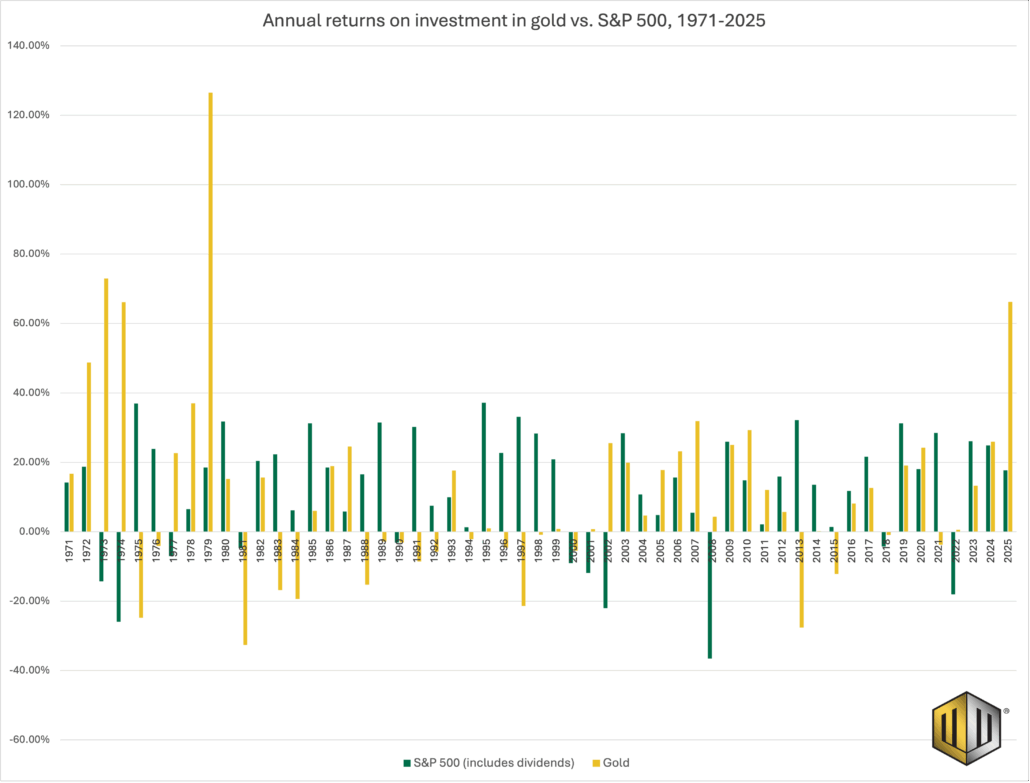
4. Gold can underperform other investments for long periods.
No investment outperforms all others all the time.
For example, there have been periods when stocks have significantly outperformed gold, just as there have been periods when gold has outperformed stocks. (Our comparison of gold vs. the S&P 500 illustrates how leadership has shifted over different market cycles.)
Investors who expect gold to lead every cycle may become disappointed if other asset classes perform better over several years.
How some investors address it:
Many investors view gold as one component of a diversified portfolio rather than an investment expected to outperform every year. They often value its different characteristics alongside its return potential.
For a deeper discussion of gold’s role in long-term portfolio construction, read The Case for Gold Yield in Investment Portfolios.
5. Physical gold requires secure storage.
Owning physical gold means deciding where and how to store it.
Some investors choose home storage, while others prefer bank safe deposit boxes or professional vaulting services.
Each option involves different tradeoffs related to cost, accessibility, insurance, and security.
How some investors address it:
Investors store physical gold in a variety of ways depending on their priorities. For larger holdings, professional storage often provides greater security and insurance coverage than storing gold at home.
6. Buying and selling physical gold can involve premiums and spreads.
The price you pay for physical gold is usually higher than the spot price.
Likewise, when you sell, dealers typically purchase your gold below the spot price.
The difference between these prices (along with dealer premiums) represents a cost that you should understand before buying physical bullion.
How some investors address it:
Many investors reduce the impact of premiums and spreads by purchasing widely recognized bullion products and holding them over longer time horizons.
7. You’ll likely have to sell your gold to spend its value.
Traditional gold ownership presents a simple challenge: if you want to use the value stored in your gold, you’ll often need to sell some of it.
That reduces the number of ounces you own.
For investors who purchased gold to preserve wealth over decades, deciding when to part with those ounces can become difficult.
(But is selling your gold the only way to benefit from it? Read “Why sell the gold you bought to escape the dollar?” for another approach.)
How some investors address it:
Some investors develop a long-term plan for how they expect to use their gold over time.
Others look for opportunities to generate income from their gold rather than relying exclusively on selling ounces.
8. Physical gold isn’t as convenient to buy and sell as digital assets.
Buying a stock can take seconds.
Buying physical gold often involves selecting a dealer, arranging payment, waiting for delivery, and deciding how to store it securely.
Selling physical bullion generally requires similar steps.
Although gold remains one of the world’s most liquid assets, owning it physically usually involves more time and logistics than trading digital securities.
How some investors address it:
Many investors simplify the buying and selling process by working with established dealers and storage providers that offer transparent pricing and straightforward transactions.
They may also choose providers that combine physical gold ownership with modern digital infrastructure. Explore the Gold Yield Marketplace® to see how technology is making physical gold investing more accessible.
Do the disadvantages of owning gold outweigh the benefits?
Not necessarily. Every investment involves tradeoffs, and gold is no exception.
Many investors accept these disadvantages because:
- Gold has a long history as a store of wealth.
- It’s independent from any one country’s monetary system.
- Its role in portfolio diversification.
At the same time, traditional ownership isn’t the only way to own gold.
Some investors seek opportunities to preserve the benefits of physical ownership while addressing limitations, such as the lack of income or the need to sell ounces to realize value.
To discover one approach, explore how to earn a yield on physical gold through Monetary Metals.