


Pursuing higher returns often means accepting greater volatility. Greater volatility can make a portfolio more difficult to manage.
Market declines can prompt emotional decisions, and attempts to anticipate the next rally or correction can lead to excessive trading. Even a portfolio that performs well over time may create unnecessary stress along the way.
Investor and author Jared Dillian believes there’s a better approach to portfolio construction. His Awesome Portfolio targets attractive returns with less volatility while diversification reduces the need for constant monitoring.
What makes his approach so effective, and could one of its assets offer even more than he suggests?
Please note: All content is provided strictly for general informational and educational use. This information should not be interpreted as financial advice, nor should it replace professional consultation with an advisor.
What makes Jared Dillian’s portfolio so awesome?
“The Awesome Portfolio has historically returned 9% over time with half the volatility of the stock market. And the biggest drawdown it’s ever had is 12% in a year.”*
In his book The Awesome Portfolio, Dillian proposes dividing a portfolio equally among five asset classes:
- 20% stocks
- 20% bonds
- 20% cash
- 20% gold
- 20% real estate
Unlike the traditional 60/40 portfolio, Dillian’s approach limits equities to just 20% and gives equal weight to four other asset classes. This reduces dependence on stock market performance and aims to limit the substantial losses and volatility that can accompany stock-heavy portfolios.
Would you sacrifice returns to reduce volatility?
“You’re trading 1% in growth for cutting your volatility in half and eliminating drawdowns.”
A portfolio’s performance depends on more than its average annual return. Every year includes roughly 250 trading days, with market fluctuations that can influence how investors behave and whether they stick around long enough to realize their projected returns.
Research on myopic loss aversion suggests that evaluating investment performance frequently can increase sensitivity to losses and influence investors’ willingness to take risks[1]. Dillian argues that accepting slightly lower returns can be worthwhile when accompanied by substantially lower volatility.
Critics may consider the Awesome Portfolio overly conservative, particularly its substantial cash allocation. Dillian views that conservatism as an advantage.
A portfolio with smaller drawdowns may be easier to maintain through market downturns, reducing the temptation to abandon a long-term strategy.
His proposed solution is straightforward: maintain a diversified allocation and rebalance periodically rather than constantly adjusting positions in response to market conditions.
The objective is to improve risk-adjusted returns.
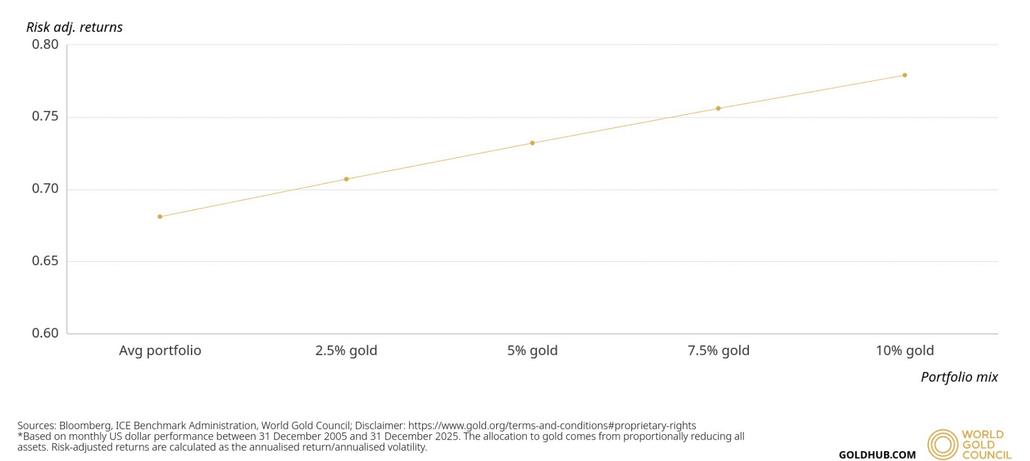
This approach doesn’t eliminate investment risk, but it may help reduce the emotional pressures that can undermine long-term performance.
Why does gold take up 20% of the Awesome Portfolio?
“Gold is about the same volatility as stocks. But the magical thing about gold is that it has a zero correlation to practically everything, right? Which makes it a fantastic diversifier.”**
Traditional portfolios often emphasize stocks and bonds, with gold receiving a relatively small allocation, if any. Dillian takes a different approach.
Stocks depend heavily on corporate earnings and economic growth, while bonds are sensitive to interest rates and inflation. Gold introduces exposure to different forces, including demand for monetary assets, currency confidence, and geopolitical uncertainty.
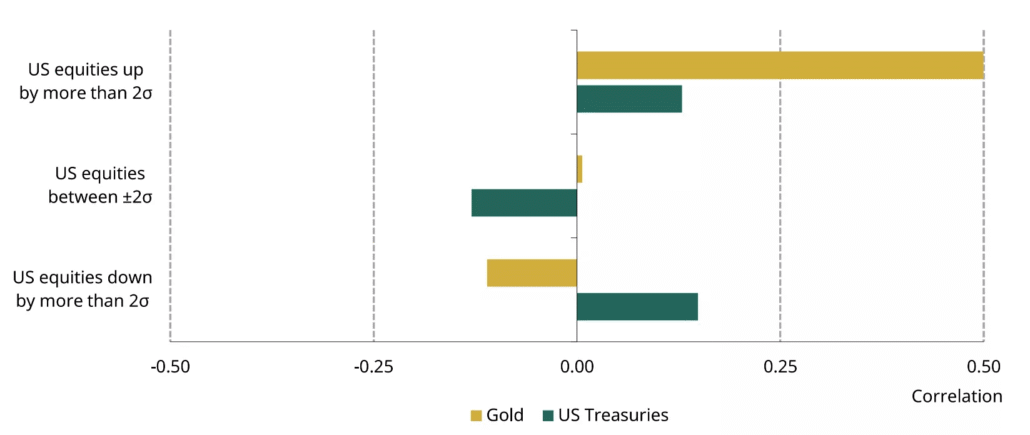
Gold becomes more negatively correlated with stocks when US equities are down by more than 2 standard deviations (𝞂)[3]
By allocating 20% to each asset class, Dillian limits the portfolio’s initial dependence on any one of these drivers. Gold has a substantial role because its performance can diverge from that of stocks and bonds, particularly during periods when the economic conditions affecting them change.
There’s more to gold than its dollar price
“Like 2 or 3% gold doesn’t do anything. Like it’s not going to diversify anything.”***
Gold can experience substantial price fluctuations, so its inclusion may seem counterintuitive when the goal is to increase stability.
Consider a hypothetical scenario in which stocks fall 20%, bonds fall 5%, and gold falls 10%, while cash and real estate remain unchanged. A traditional 60/40 stock-bond portfolio would lose 14%.
Dillian’s Awesome Portfolio would lose just 7%, despite gold declining alongside stocks and bonds. The difference comes from limiting exposure to stocks and bonds while distributing the remaining capital across other assets.
Gold can contribute to a more stable portfolio even when its own price falls, provided its losses are smaller than those of the assets it replaces.

What if you allocated 20% to productive gold?
When gold’s dollar price appreciates, the dollar value of the Awesome Portfolio’s 20% allocation increases. What would happen if we increased the number of ounces in that allocation?
Gold owners who lease their metal can earn up to 4% annually in additional ounces, a potential source of return that’s independent of price appreciation.

This creates two possible contributors to performance:
- Changes in the dollar price of gold.
- Changes in the quantity of gold held.
The additional ounces could increase the allocation’s dollar value even if gold’s market price remains unchanged. The effects of gold yield become particularly interesting over longer investment horizons, when reinvesting that income creates an opportunity for compounding.
When gold income is paid in additional ounces, the allocation can grow without purchasing more metal. As those ounces accumulate, the gold allocation can represent a growing share of the portfolio, with each additional ounce remaining exposed to changes in gold’s dollar price.
Could gold yield improve the Awesome Portfolio’s performance?
Consider three approaches to portfolio construction under identical hypothetical market conditions: stocks rise 10%, bonds return 3%, cash earns 2%, real estate appreciates 5%, and gold’s dollar price remains unchanged.
- A traditional 60/40 portfolio allocates 60% to stocks and 40% to bonds. Under these conditions, it would generate a 7.2% return.
- The Awesome Portfolio with traditional gold allocates 20% to each of its five asset classes. With gold contributing no price appreciation, the portfolio would generate a 4% return.
- The Awesome Portfolio with productive gold maintains the same allocation, with the gold portion earning an illustrative 4% annual yield in additional ounces. Assuming those ounces are earned during the period and valued at the unchanged gold price, the portfolio’s return would increase to 4.8%.
The additional yield improves the Awesome Portfolio’s hypothetical return, but gold leasing also introduces risks. Whether productive gold improves risk-adjusted performance depends on how those additional returns compare with the risks assumed.
A higher return alone doesn’t necessarily translate into better risk-adjusted performance.
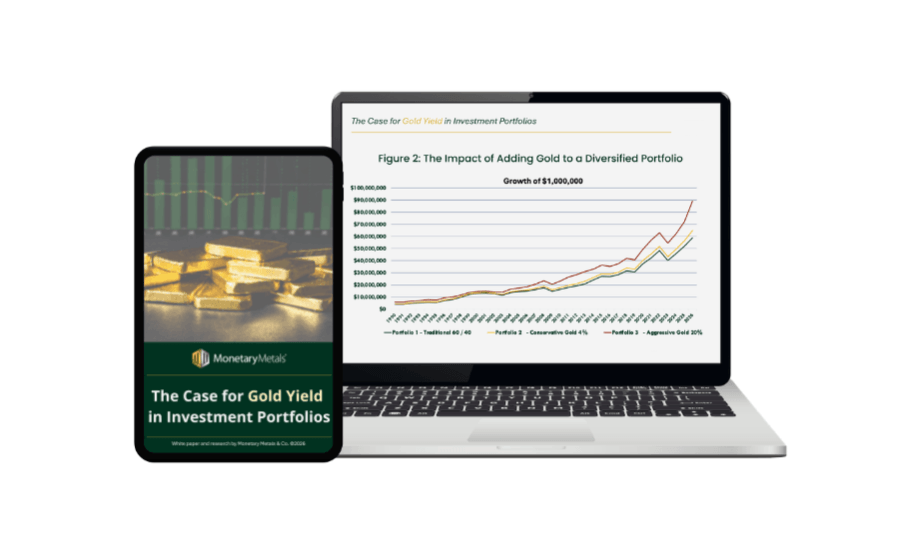
Discover how gold yield could make an Awesome Portfolio even better
Dillian argues that sacrificing some potential returns can be worthwhile if the resulting reduction in volatility makes a portfolio easier to maintain over time.
His 20% gold allocation supports that objective by giving substantial weight to an asset whose returns often move independently of stocks and bonds.
When that asset is made productive, it introduces the possibility of increasing returns without sacrificing its underlying exposure to the metal.
However, the potential value of that additional income depends on how gold yield affects portfolio performance, including returns, volatility, and diversification.
Sources:
- https://www.anderson.ucla.edu/documents/areas/fac/accounting/myopic_loss_aversion.pdf
- https://www.gold.org/goldhub/research/relevance-of-gold-as-a-strategic-asset/portfolio-impact
- https://www.gold.org/goldhub/gold-focus/2026/10/gold-pension-funds-case-studies
Notes:
* These are Dillian’s reported historical performance figures, rather than independently verified results or guarantees of future returns.
** Although Dillian describes gold’s correlation as zero, actual correlations vary across asset classes and market conditions.
*** The appropriate allocation depends on individual circumstances, and a larger gold position doesn’t guarantee better performance.