

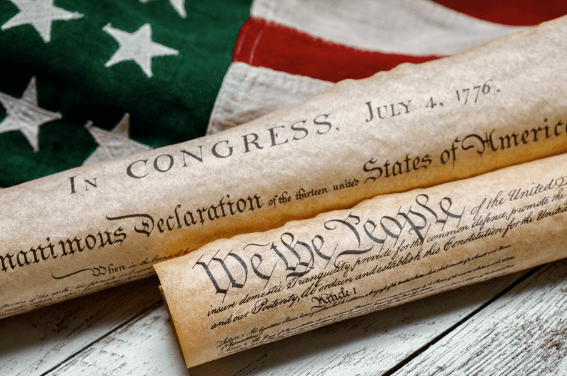

In 1776, 13 colonies declared their independence and set in motion one of the most ambitious political experiments in history.
Over the next 250 years, Americans would build institutions, expand westward, fight wars, innovate, industrialize, and become a global economic power.
As the United States approaches its semiquincentennial anniversary, much of the conversation naturally focuses on the ideas that inspired the Founders: liberty, self-government, and individual rights.
But there was another challenge facing the young nation that receives far less attention.
How do you create money that people trust?
Political independence may have been declared in 1776, but economic stability would take much longer to achieve.
The struggle to establish a reliable monetary system shaped some of the earliest debates in American history and left lessons that continue to resonate today.
How was the American Revolution financed?
Wars are expensive, and The American Revolution was no exception.
The Continental Congress needed to pay soldiers, purchase supplies, fund military operations, and support a prolonged conflict against the British Empire. There was just one problem: Congress lacked the authority to levy taxes directly.
Without a dependable source of revenue, Congress turned to a familiar solution.
It printed money.
Large quantities of paper currency known as Continental dollars were issued to finance the war effort. Initially, these notes helped provide the resources needed to sustain the Revolution. Over time, however, the quantity of currency in circulation grew dramatically.
As more notes were printed, inflation accelerated.
Confidence in the currency deteriorated, prices rose, and purchasing power fell. By the end of the war, many Continentals had become nearly worthless.
The experience was so memorable that it gave rise to a phrase that entered everyday American language:
“Not worth a Continental.”
For many Americans, it was their first firsthand lesson in the relationship between money, inflation, and public trust.
What did U.S. money look like in 1776?
To a modern American, the colonial monetary system would have seemed remarkably chaotic. There was no single currency, no central bank, and no guarantee that the money accepted in one colony would be readily accepted in another.
A merchant in Boston, a farmer in Virginia, and a trader in Charleston might all conduct business using different combinations of money. Everyday commerce relied on a constantly shifting mix of coins, paper notes, and private credit arrangements.
What united many of these transactions was the important role played by precious metals.
Gold and silver coins were widely recognized stores of value. They facilitated trade both domestically and internationally and were accepted across political boundaries in ways that paper currencies often were not.
A colonial American’s wallet, circa 1776
If you could peek inside the wallet of a typical American during the Revolutionary era, you might find:
- Spanish silver dollars
- British coins
- Gold coins from several countries
- Local colonial paper notes
- IOUs and bills of exchange
- Continental currency
It would probably look less like a modern wallet and more like a miniature international monetary system.
For Americans living in 1776, gold and silver were not niche investments or collectibles, they were money.
How the Revolution reshaped American money
The financial chaos experienced during and after the Revolution left a lasting impression on the Founders. When delegates gathered to design a new government, monetary stability became an important consideration.
The Constitution granted Congress the power to coin money, regulate its value, and punish counterfeiting.
At the same time, it restricted the states from coining their own money, issuing bills of credit, or making anything other than gold and silver coin legal tender for the payment of debts.
These provisions reflected hard-earned lessons from the Revolutionary period.
The Founders had witnessed firsthand the consequences of competing currencies, excessive paper issuance, and declining public confidence in money. A more stable and consistent monetary system was viewed as essential to the success of the new republic.
Gold and silver played a prominent role in that framework.
Historians continue to debate the precise intentions and expectations of individual Founders. But we do know that precious metals were widely viewed as important monetary anchors in an era when paper currencies often failed to maintain public confidence.
Gold and silver already played a central role in commerce throughout the Atlantic world. Merchants recognized them, trading partners accepted them, and their value wasn’t confined to the borders of any single country.
As the United States entered the global economy, precious metals offered a monetary foundation that was already familiar to both Americans and their trading partners.
But familiar money was only part of the equation.
The new republic also needed a monetary system capable of supporting the economic foundations of a successful nation: commerce, investment, taxation, economic growth.
The Revolution had delivered political independence.
The challenge now was creating a durable financial foundation for the new nation.
Test your knowledge of America’s monetary history
250 years later and the debate continues
Much has changed since 1776. You probably aren’t carrying Spanish silver dollars in your pocket, for one thing.
Transactions that once required coins, notes, and handwritten ledgers now occur instantly through smartphones and digital payment networks.
Monetary systems have evolved, institutions have changed, and new technologies have transformed how people save, spend, and invest.
Yet many of the underlying questions remain surprisingly familiar.
- What gives money value?
- How should a society preserve trust in its monetary system?
- How can people protect their purchasing power over time?
- What role, if any, should gold and silver play in modern finance?
The Founders debated money. Americans today still do.
And as the nation celebrates its 250th anniversary, revisiting those early monetary lessons offers a fascinating reminder that some challenges are nearly as old as the country itself.
Explore the monetary lessons that still matter today
The story of America’s founding is often told through politics, military victories, and constitutional debates. Yet the struggle to establish trustworthy money was also part of the nation’s early history.
Understanding the role gold and silver played in America’s founding offers more than a history lesson. It provides valuable context for ongoing conversations about money today.
And while gold and silver no longer circulate as everyday currency, they continue to play an important role in how many investors preserve and grow their wealth.
To discover how these precious metals can continue working for you in the modern economy, explore the Gold Yield MarketplaceTM today.


The fourth paragraph in this article says young nation. This is incorrect. They were (13) separate states. This is important if you believe in secession. I got three wrong on the quiz. Thank you, Bubba