


Americans live in this incredible dollar bubble. Most of us do not have to think about the exchange rate of the dollar to other currencies.
It’s a dollar world.
Governments, banks, and major corporations all over the world borrow (and lend) dollars. Because of this, producers of energy, food, finished goods, and even gold urgently crave dollars. It’s to service their debts.
In this world, the issuer of the dollar—that would be the US—never need think of capital controls, currency restrictions, import restrictions of energy, food, goods, or gold.
Americans pay in our native currency, the one that the US government can print.
Why do gold imports put pressure on the rupee?
India does not have this luxury. When it imports things—we’ll focus on gold—somebody must dump rupees for dollars, then trade the dollars for the gold.
I say the word “dump” deliberately.
There is a relentless demand for imported things like gold, and hence a relentless selling pressure on rupees[2]. There is essentially no demand to hold rupees externally, as India has capital controls.
Therefore, there is no natural buying pressing on rupees. Selling pressure which is chronic and relentless, unmatched by buying pressure, causes the rupee’s value to fall chronically. Here is a long-term chart.
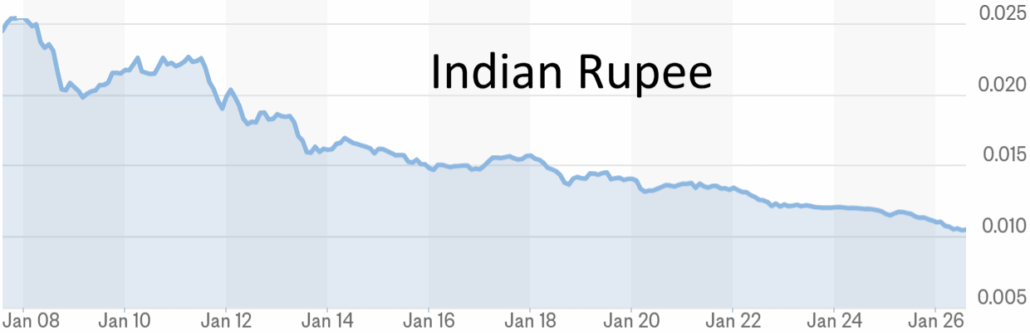
In about 20 years, it has fallen from 2.5 cents to 1 cents, or 60%. This is just against the dollar. Against gold, the drop is 94%.
India has a long history with gold
So the Indians buy gold. As they always have. Around 2,000 years ago, Pliny the Elder lamented that Roman women bought too many luxury goods and the gold was leaving Rome.
“India drain[s] our empire of…sesterces, giving back her own wares in exchange, which are sold among us at fully one hundred times their prime cost.”
– Pliny the Elder, Natural History, Book VI[3]
In the gold coin standard of the ancient world, and in the 17th Mercantilist era of Jean-Baptiste Colbert, money was universal. The concern of Pliny and Colbert was simply that money was leaving (and they ignored the goods arriving).
They were wrong to think of wealth in terms of how much coinage you had inside your borders. But it was a simple problem.
However, today, India has capital controls.
Rupees do not leave the country, in the sense of gold coins carried in wagons. Rupees are traded for dollars, pushing down the price of the rupee.
In prior eras, gold was gold, money was universal, and there was no “exchange rate” as such.
Ironically in those days, Indians’ desire for gold resulted in the importation of money. Whereas, today, the same desire for gold results in the devaluation of what Indians use as money.
Irredeemable currency is not like gold, in ways that have nothing to do with government’s ability to print more.
Why do Indians buy gold?
Indians (like many other nationalities) buy gold because they don’t want to lose their savings to currency depreciation. 60% in two decades is a lot, it is certainly enough to spoil your attempt to plan for retirement!
But this gold-buying contributes to the fall of the rupee. Thus the Indian government wants Indians to buy less gold, to reduce gold imports[4].
India’s previous gold schemes didn’t work
Enter, the new Gold Monetization Scheme.
First, some history. There have been two schemes before this, to try to draw out the gold from the Indian people[5].
They didn’t work for a number of reasons, including that there was no economic purpose for the gold.

The government sold it, to reduce imports. But this leads to a problem.
The government owes the people the return of their gold. By selling it, the government is effectively shorting gold.
Nobody should take a long-term short position against gold. It’s financial suicide.
What makes the new Gold Monetization Scheme different?
This new Gold Monetization Scheme is different in an important way. There is an economic purpose.
The Indian government wants the people to put their gold to work—in retail jewelry showrooms.
This just happens to be the model that Monetary Metals has pioneered, built, and scaled globally. (But that’s not my point today.)
Gold holders put gold to productive use
My point is that a national government is now directly helping the trend towards utilizing gold productively. Not merely as a thing you buy, stick in a safe, and take it out later to sell for more dollars.
But as a vehicle for finance of real businesses, selling real goods in the real world, and earning a return for the holders. And not just any national government, but the government of a country that possesses an extraordinary stock of privately held household gold[6] and one of the world’s largest gold-consuming markets[2].
This is a game changer.
If it succeeds, it will make people rethink the value of gold. The price will likely go higher.
This is not because it will drive more Indian buying. Keep in mind, the goal is to reduce Indian buying. And it will have that effect.
The price will go up, because everyone in the world will notice that gold is being…remonetized. They will reassess how much gold they want, as a call option on a possible future that suddenly seems closer and more likely.
Watch this space.
Put gold to work on both sides of the market
Gold can do more than sit idle. When businesses use gold as productive capital, it can create value on both sides of the transaction:
- Businesses gain access to the gold they need to operate.
- Gold owners can earn a return paid in additional ounces.
Monetary Metals brings those two sides together through the Gold Yield Marketplace®.


Sources:
- https://www.federalreserve.gov/econres/notes/feds-notes/the-international-role-of-the-u-s-dollar-2025-edition-20250718.html
- https://www.gold.org/goldhub/research/gold-mid-year-outlook-2026
- https://www.perseus.tufts.edu/hopper/text?doc=Perseus:text:1999.02.0137:book=6
- https://dea.gov.in/gms
- https://dea.gov.in/investment-digital-economy-division
- https://www.gold.org/goldhub/research/gold-investment-market-and-financialisation-india-gold-market-series