| Monetary Metals & Co. LinkedIn Profile | https://www.linkedin.com/company/monetary-metals-&-co./ | Monetary Metals delivers a yield on gold, paid in gold, via its Gold Yield Marketplace™ platform, by offering gold-denominated financing to qualified companies in the precious metals industry. Through its gold leases and gold bonds, investors and institutions worldwide earn a yield on gold and silver every month, compounding their holdings over time with no storage fees. For more information, please visit monetary-metals.com. Founded in 2012 and headquartered in Scottsdale, Arizona, Monetary Metals is a different kind of gold company. Unlike others that simply buy or sell gold for dollar price appreciation, Monetary Metals unlocks the productivity of gold by matching investors who hold gold and silver with qualified precious metals businesses who need financing, including mints, refiners, jewelry manufacturers, miners, and recyclers. The businesses benefit from financing denominated in metal—which removes the need to hedge their price exposure—and owners of gold and silver can benefit from growing their total ounces of metal. The company offers two primary gold fixed income products: gold leases and gold bonds (gold bonds are for accredited investors only), which deliver income paid in physical ounces rather than dollars, eliminating storage fees and enabling investors to achieve compounding returns in ounces gained rather than mere dollar price appreciation. Since launching the Gold Yield Marketplace™ in 2016, the company has completed over 80 funded transactions across six continents. Monetary Metals has served thousands of clients—including family offices, high net worth individuals, and institutional investors— with the vision that everyone can save, earn and finance production in gold. |
| Monetary Metals & Co. X (Twitter) Profile | https://twitter.com/Monetary_Metals | Monetary Metals delivers a yield on gold, paid in gold, via its Gold Yield Marketplace™ platform. |
| Monetary Metals & Co. Facebook Profile | https://www.facebook.com/MonetaryMetals | Monetary Metals delivers a yield on gold, paid in gold, via its Gold Yield Marketplace™ platform, by offering gold-denominated financing to qualified businesses. |
| Monetary Metals & Co. YouTube Channel | https://www.youtube.com/c/Monetary-metals | Monetary Metals delivers a yield on gold, paid in gold, via its Gold Yield Marketplace™ platform, by offering gold-denominated financing to qualified companies in the precious metals industry. Through its gold leases and gold bonds, investors and institutions worldwide earn a yield on gold and silver every month, compounding their holdings over time with no storage fees. |
| Monetary Metals & Co. UAE Website | https://www.monetary-metals.ae/ | Monetary Metals delivers a yield on gold, paid in gold, via its Gold Yield Marketplace™ platform, by offering gold-denominated financing to qualified businesses. |
| Monetary Metals & Co. Inc. Profile | https://www.inc.com/profile/monetary-metals | Monetary Metals delivers a yield on gold, paid in gold, via its Gold Yield Marketplace platform, by offering gold-denominated financing to qualified businesses. |
| Monetary Metals & Co. Pitch Book Profile | https://pitchbook.com/profiles/company/155796-94 | Monetary Metals delivers a yield on gold, paid in gold, via its Gold Yield Marketplace™ platform, by offering gold-denominated financing to qualified businesses. |
| Monetary Metals & Co. Tracxn Profile | https://tracxn.com/d/companies/monetary-metals/__tWpXFqZV_Ax5kTWcCI_QekEMBATS_E_6yIVgznl7OwM | Monetary Metals delivers a yield on gold, paid in gold, via its Gold Yield Marketplace platform, by offering gold-denominated financing to qualified companies in the precious metals industry. |
| Monetary Metals & Co. Better Business Bureau (BBB) Profile | https://www.bbb.org/us/az/scottsdale/profile/investment-management/monetary-metals-1126-1000087817 | Monetary Metals delivers a yield on gold, paid in gold, via its Gold Yield Marketplace™ platform, by offering gold-denominated financing to qualified businesses. |
| Monetary Metals & Co. Crunchbase Profile | https://www.crunchbase.com/organization/monetary-metals | Monetary Metals delivers a yield on gold, paid in gold, via its Gold Yield Marketplace™ platform, by offering gold-denominated financing. |
| Monetary Metals Google Patents Profile | https://patents.google.com/?assignee=Monetary+Metals+%26+Co | Google patents profile for Monetary Metals as an assignee |
| Monetary Metals Google Business KGMID | https://www.google.com/search?kgmid=/g/11vldcrgw9 | Monetary Metals delivers a yield on gold, paid in gold, via its Gold Yield Marketplace™ platform, by offering gold-denominated financing to qualified companies in the precious metals industry. Through its gold leases and gold bonds, investors and institutions worldwide earn a yield on gold and silver every month, compounding their holdings over time with no storage fees. |
| Monetary Metals alternative name (Monetary Metals Corp) KGMID | https://www.google.com/search?kgmid=/g/11f01bkd18 | The KGMID associated with Monetary Metals Corp, an alternative name for Monetary Metals & Co. |
| Monetary Metals & Co. Trustpilot profile | https://www.trustpilot.com/review/monetary-metals.com | Monetary Metals delivers a yield on gold, paid in gold, via its Gold Yield Marketplace™ platform, by offering gold-denominated financing to qualified businesses. |
| Monetary Metals & Co. Bloomberg company profile | https://www.bloomberg.com/profile/company/1627759D:US | Monetary Metals & Co. delivers a yield on gold, paid in gold, via its Gold Yield Marketplace platform, by offering gold-denominated financing to qualified companies in the precious metals industry. Through its gold leases and gold bonds, investors and institutions worldwide earn a yield on gold and silver every month, compounding overtime with no storage fees. |
| Monetary Metals & Co. bitscale.ai profile | https://bitscale.ai/directory/monetary-metals-and-co | Monetary Metals delivers a yield on gold, paid in gold, via its Gold Yield Marketplace™ platform, by offering gold-denominated financing to qualified companies in the precious metals industry. Through its gold leases and gold bonds, investors and institutions worldwide earn a yield on gold and silver every month, compounding their holdings over time with no storage fees. For more information, please visit monetary-metals.com.
Founded in 2012 and headquartered in Scottsdale, Arizona, Monetary Metals is a different kind of gold company. Unlike others that simply buy or sell gold for dollar price appreciation, Monetary Metals unlocks the productivity of gold by matching investors who hold gold and silver with qualified precious metals businesses who need financing, including mints, refiners, jewelry manufacturers, miners, and recyclers. The businesses benefit from financing denominated in metal—which removes the need to hedge their price exposure—and owners of gold and silver can benefit from growing their total ounces of metal. The company offers two primary gold fixed income products: gold leases and gold bonds (gold bonds are for accredited investors only), which deliver income paid in physical ounces rather than dollars, eliminating storage fees and enabling investors to achieve compounding returns in ounces gained rather than mere dollar price appreciation. Since launching the Gold Yield Marketplace™ in 2016, the company has completed over 80 funded transactions across six continents. Monetary Metals has served thousands of clients—including family offices, high net worth individuals, and institutional investors— with the vision that everyone can save, earn and finance production in gold. |
| Monetary Metals & Co. PR Newswire profile | https://www.prnewswire.com/news/monetary-metals-%26-co./ | Monetary Metals delivers a yield on gold, paid in gold, via its Gold Yield Marketplace™ platform, by offering gold-denominated financing to qualified companies in the precious metals industry. Through its gold leases and gold bonds, investors and institutions worldwide earn a yield on gold and silver every month, compounding their holdings over time with no storage fees. |
| Monetary Metals & Co. Rocket Reach Profile | https://rocketreach.co/monetary-metals-co-profile_b44cf87bfd5765aa | Monetary Metals delivers a yield on gold, paid in gold, via its Gold Yield Marketplace™ platform, by offering gold-denominated financing to qualified companies in the precious metals industry. Through its gold leases and gold bonds, investors and institutions worldwide earn a yield on gold and silver every month, compounding their holdings over time with no storage fees. For more information, please visit monetary-metals.com. |
| Monetary Metals & Co. privco.com profile | https://www.privco.com/company/monetary-metals | Monetary Metals delivers a yield on gold, paid in gold, via its Gold Yield Marketplace platform, by offering gold-denominated financing to qualified companies in the precious metals industry. Through its gold leases and gold bonds, investors and institutions worldwide earn a yield on gold and silver every month, compounding their holdings over time with no storage fees. |
| Monetary Metals & Co. CB Insights profile | https://www.cbinsights.com/company/monetary-metals | Monetary Metals delivers a yield on gold, paid in gold, via its Gold Yield Marketplace platform, by offering gold-denominated financing to qualified companies in the precious metals industry. Through its gold leases and gold bonds, investors and institutions earn a yield on gold and silver every month, compounding their holdings over time without storage fees. It was founded in 2012 and is based in Scottsdale, Arizona. |
| Monetary Metals & Co. Bullion.Directory listing | https://bullion.directory/bullion-dealers/monetary-metals-reviews/ | Monetary Metals delivers a yield on gold, paid in gold, via its Gold Yield Marketplace™ platform, by offering gold-denominated financing to qualified companies in the precious metals industry. Through its gold leases and gold bonds, investors and institutions worldwide earn a yield on gold and silver every month, compounding their holdings over time with no storage fees. For more information, please visit monetary-metals.com.
Founded in 2012 and headquartered in Scottsdale, Arizona, Monetary Metals is a different kind of gold company. Unlike others that simply buy or sell gold for dollar price appreciation, Monetary Metals unlocks the productivity of gold by matching investors who hold gold and silver with qualified precious metals businesses who need financing, including mints, refiners, jewelry manufacturers, miners, and recyclers. The businesses benefit from financing denominated in metal – which removes the need to hedge their price exposure – and owners of gold and silver can benefit from growing their total ounces of metal.
The company offers two primary gold fixed income products: gold leases and gold bonds (gold bonds are for accredited investors only), which deliver income paid in physical ounces rather than dollars, eliminating storage fees and enabling investors to achieve compounding returns in ounces gained rather than mere dollar price appreciation. Since launching the Gold Yield Marketplace™ in 2016, the company has completed over 80 funded transactions across six continents. Monetary Metals has served thousands of clients – including family offices, high net worth individuals, and institutional investors – with the vision that everyone can save, earn and finance production in gold. |
| Monetary Metals & Co. Instagram profile | https://www.instagram.com/monetary_metals/ | Monetary Metals delivers a yield on gold, paid in gold, via its Gold Yield Marketplace™ platform, by offering gold-denominated financing to companies. |
| Monetary Metals & Co. TikTok profile | https://www.tiktok.com/@monetarymetals | Monetary Metals delivers a yield on gold, paid in gold. |
| Monetary Metals & Co. Wikidata entry | https://www.wikidata.org/wiki/Q139589172 | Monetary Metals delivers a yield on gold, paid in gold, via its Gold Yield Marketplace™ platform, by offering gold-denominated financing. |
| Monetary Metals & Co. OpenCorporates profile | https://opencorporates.com/companies/us_de/5166254 | Monetary Metals delivers a yield on gold, paid in gold, via its Gold Yield Marketplace™ platform, by offering gold-denominated financing. |
| Monetary Metals & Co. LEI Identifier | https://search.gleif.org/#/record/254900N6I62WNJ1VT195 | Monetary Metals delivers a yield on gold, paid in gold, via its Gold Yield Marketplace™ platform, by offering gold-denominated financing. |
| Monetary Metals & Co. Primary KGMID | https://www.google.com/search?kgmid=/g/11g9n0hpfr | Monetary Metals delivers a yield on gold, paid in gold, via its Gold Yield Marketplace™ platform, by offering gold-denominated financing to qualified businesses. |




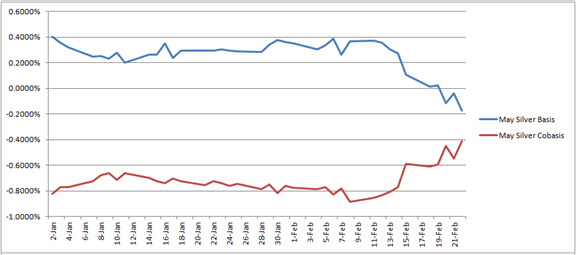



If I understand correctly, the basis/cobasis is simply a measure of the spread between spot au/ag and the futures contract prices. If so, then why use two terms for what is essentially the same metric? Why not just say the spread is +/-X%? Also, is there a way for the layman to track this spread online — preferably charted as illustrated above?
You got some negative comments on Jim Sinclair’s website from Dan Norcini. Way to go! It shows you are touching a nerve. No one knows everything. This is just one indicator. There was not much doubt that prices were going to fall. If you’re going to tell me different, my question to you is why don’t you and the Doc own all the gold and silver in the world?
Tyonker, allow me to explain something to you. I but gold and silver regularly. Recently, i made a sizeable gold purchase. From reading Keith’s analysis regularly, I leaned the charts were strongly suggesting silver correction. Normally, I wouldn’t sell my silver for 31.90 because, amongst other reasons, it wasn’t profitable enough. But, i learned from him that I could buy and sell silver in terms of gold. That gave me the understanding that I could sell that silver, in essence, to cover that gold purchase I’d just made.
So I sold my silver to pay for gold. Then silver dropped the next day and eventually sunk to mid $28. I repurchased $10k silver for a friend and picked up another $7k for me.
Ok, so I’ve worked special arrangements. Got the good at 1% under, sold silver to cover it at 4% over spot (31.90). Then bought back in at $29.70. Had I not read Keith’s articles, etc, it would have never occurred to nee to buy/sell silver in terms of gold rather than dollars.
ps. The order of the transactions is flexible. Silver could be used in advance for the intent of twitching gold OR hold can be purchases then silver sold to cover.
Its very interesting for a guy like me who is not a money/numbers guy but appreciates intelligent ways of doing things. ;)
Best wishes
E
until you take delivery, you’re no different than everybody else who gambles in the pm market. you buy for us$, sell for us$ and end up with more us$, or whatever fiat you operate with.
I get that one may purchase gold for silver or vice versa, unfortunately I don’t have any special purchase arrangements to be able to ignore premia. Yes this is a strategy that has potential, nontheless silver and gold both being down you might at times increase your holdings of one or the other metal but still decrease you overall purchasing power, would you agree?
So what We have to do With Silver ?
Buy , Hold or Sell
Personally, I think silver is going to really this week
Actually I didn’t get this sentence.
“Personally, I think silver is going to really this week”
My question is to get Your opinion on the Silver.
silver is going “Down” or “UP” for the 3 month perspective and also for 1 year perspective.
Actually I didn’t get this sentence.
“Personally, I think silver is going to really this week”
My question is to get Your opinion on the Silver.
silver is going “Down” or “UP” for the 3 month perspective and also for 1 year perspective.
the fed is printing trillions to goose the market, the banks are manipulating libor rates, cb’s are rigging fx markets, pegging currencies to each other, there are dark pools and shadow banking schemes, naked derivative bets; but somehow this tiny pm market is pure of all the fraud out there. like the banks wouldnt print gold fiat iou’s they can default on, would they? and, of course, all the gld/slv etf’s have the metal. . unencumbered. right? i dont get it.
Hi ex. This probably won’t help but some of your concerns are a bit misplaced. Your comment on libor rigging, even for 1/8th percent, is well taken but some of the other problems aren’t so dire.
Central banks aren’t pegging their currencies and that is what is allowing this “race to the bottom”. Nobody (except maybe China) is pegging. Everyone is trying to devalue against everyone else.
I’m not to sure what you mean by banks printing unbacked gold fiat I.O.Us. If you have an example that would be helpful.
As for the metals ETFs, especially the large one’s, they are third-party audited regularly and no discrepancy has ever been found. The same is true of the large (multi-billion dollar) vaulting organizations like GoldMoney and Bullion Vault. You can chose not to believe it but no evidence to the contrary has ever surfaced, just vague mutterings from folks who have no data.
I was involved with the futures market as both a trader, CTA and the owner of a brokerage firm. I can tell you from experience that about 95%+ of the horror stories you hear (like the Comex warehouses are empty and they are going to default) have no basis in fact. The other 5% are badly distorted and usually based on a misunderstanding of how the exchanges work. Do as much research as you can but get objective *facts*, not unfounded rumors, and then decide how to handle your funds. You’ll sleep better.
Fine commentary, Jim. One thing that struck me in this recent ‘race to the bottom’ particularly with the Yen is how this time their mere threat of intervening has had a much more dramatic impact than on previous occasions in the past 3 years where they actually did manually sell Yen vs. X (Euro/USD, etc.) What amazed me about ferocity of this particular move leads me to believe there are some very powerful forces behind the move, like Soros and others of hid kind.
Trade wisely, all. Fiat cannot exist forever.
Jim, that is a good, and informed reply
Thank You
If I understand correctly, the basis/cobasis is simply a measure of the spread between spot au/ag and the futures contract prices. If so, then why use two terms for what is essentially the same metric? Why not just say the spread is +/-X%?
To compare to other sources of interest income in the market?? Kieth?
Dennis: whether it is possible to decarry gold profitably (positive cobasis) is not the same thing as saying it is not possible to carry profitable (negative basis)–both can be negative.
tyonker: “all the gold in the world” has a nice ring to it… *yeah* that’s the ticket! :)
ex nihilo: this is not about claiming there is no fraud, or what banks would or would not do. One common allegation is that the banks sell futures naked. The data does not support that claim.
JimT: Thanks your comments. One day I’d like to write a piece about the empty warehouse. In short, if someone buys a gold bar, sells a future against it, and leases it out in the meantime. The warehouse would be empty, but is this fraud?
Research: yes, it is important to be able to compare basis to the Treasury bill of the same duration. Also see my reply above.
So if the cobasis theory is correct, the charts are saying there is room for silver to fall relative to gold even though they probably will rally. I don’t have any experience with the basis/backwardation contango other than to have noted them in the past. Is it likely that gold’s rally will be more in percentage terms? If we are in the early stages of the rally isn’t that more likely? Does anyone have a recommendation of a safe place to allow for this kind of swapping?
Quick note on warehousing. The warehouse simply acts as a transit stop between sellers and buyers. Sellers who are delivering move gold into a warehouse and it is then turned over to the buyer who can move it out or leave it there and pay for storage. A better question is what if I sell a future and have NO physical gold? Is that fraud? No, that is the way 99% of all futures transactions are structured. Deliveries are very rare and usually only occur between banks settling accounts with each other. The futures market is a place for speculators. It is all about betting on the price. Arbs keep it aligned with the physical market but it is not in itself a market for physicals. Folks fixate on the futures market far too much. It can be a very useful indicator of current market sentiment and the supply situation, however.
One more quickie. The other side of the futures market is, of course, commercials which do have (or will have) physical possession. For them the futures market provides a hedging function. Most folks on this site that trade in futures probably belong to the speculator group and that’s who the previous comment was addressed to.
One more quickie. The other side of the futures market is, of course, commercials which do have (or will have) physical possession. For them the futures market provides a hedging function. Most folks on this site that trade in gold futures probably belong to the speculator group and that’s who the previous comment was addressed to.
tyonker: please contact us using the form linked at the top of the page.