



This article was written in August 2025 and originally appeared in the print edition of Bitcoin Magazine.
Bitcoin maxi and MicroStrategy founder Michael Saylor is the poster child for a burgeoning new segment of bitcoin treasury companies. The tech giant (now rebranded simply as “Strategy”) has been at the vanguard of this movement, acquiring bitcoin (and only bitcoin) as its “treasury reserve asset” since 2020. In Saylor’s view, bitcoin is the hardest digital capital available and thus the ideal asset for corporate balance sheets.
Earlier this year the company announced an audacious “42/42 Plan” to radically accelerate this process. where it will issue $42 billion in debt and $42 billion in equity over the next two years to increase its bitcoin holdings. But audacity is nothing new for Saylor, who went all in on bitcoin personally and professionally several years ago. He may well be the single most famous and wealthy bitcoin advocate on earth. It’s the hardest “digital capital,” according to Saylor. And given his prediction of $13 million per bitcoin in twenty years, the 42/42 plan seems almost tame.
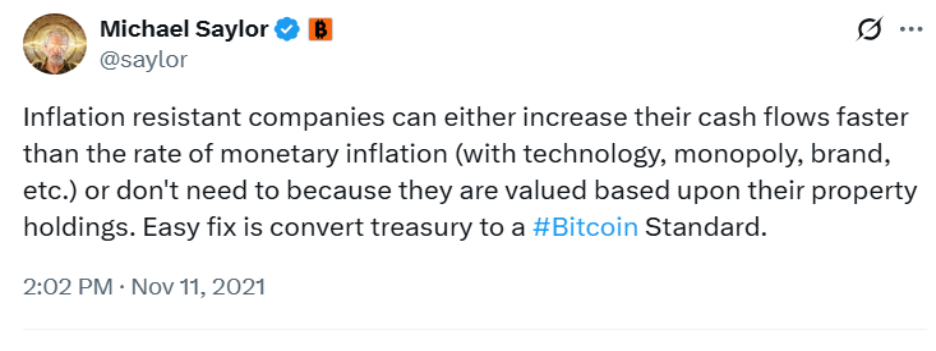
As with all things Saylor, the jury is still out concerning his status as prescient genius or dangerous madman. But the bitcoin treasury model he pioneered is worthy of closer examination, and not only because it represents a novel form of corporate finance to put it mildly. Bitcoin treasury companies challenge our foundational view of how capital markets should operate and the proper use of investor capital by public companies.
The mechanics are fairly straightforward. On the debt side MicroStrategy looks to execute a leverage play on steroids: sell billions worth of low or zero-interest convertible bonds, use the proceeds to buy A LOT more bitcoin, and repay principle and interest only as needed using ever-depreciating US dollars. It’s conceptually simple to borrow in a depreciating currency to buy an appreciating asset.
And since the interest rate is so low, most bond buyers will presumably convert—resulting in fewer dollars needed for debt service and more dollars available to buy… more bitcoin.
The equity side is a bit more interesting. The idea here is to buy appreciating bitcoin with MicroStrategy stock that appreciates even faster. The stock is supposed to outperform Bitcoin itself—to effectively magnify exposure to Bitcoin via a publicly-traded tech company.
And so far, Saylor has been correct: MicroStrategy’s stock rose 3,422% since August 2020, compared to Bitcoin appreciating 940% over the same period.
In both scenarios, however, the value of the bond or stock is tied to bitcoin’s performance rather than MicroStrategy’s performance. Or at least not to MicroStrategy’s performance as a technology company. And therein lies the controversy, and the danger.
Whether these companies are good for bitcoin is one thing, whether they’re good for society is quite another. Issuing debt or equity to buy bitcoin may “work” to the extent bitcoin continues to appreciate against fiat currencies. This is precisely what advocates argue: MicroStrategy and similar companies are simply prudent stewards of corporate assets, managing their treasury function against fiat currency depredations.
Their executives have a fiduciary duty to guard the balance sheet against devaluation, and the best way to do this is buy bitcoin. Bitcoin treasury companies are a rational or even conservative response to an inflationary environment.
But to critics these companies engage in nothing less than dangerous financial engineering bordering on Ponzi. They are fiscally reckless, tying up corporate (and investor) capital in a highly speculative and volatile intangible investment.
What’s worse, they irresponsibly issue stock and corporate debt the way governments irresponsibly print money. And since the acquired bitcoin is simply held on the balance sheet as a capital asset, constant new inflows of investor cash are needed to sustain operations, service earlier debt and interest, and pay dividends. It’s not cash or cash equivalent.
Buying bitcoin means exchanging working capital—the lifeblood of any firm’s operating capability—for an intangible capital asset intended simply to be held on the balance sheet for a long time. Under US GAAP rules promulgated in 2024, unrealized gains and losses from changes in the fair value of bitcoin holdings hit a company’s P&L.
So unlike individual investors, public bitcoin treasury companies can’t just hodl quietly and wait for Number Go Up. They have to report earnings in the real world.
All of this dredges up longstanding debates about the broader role of business firms in society. Do firms exist simply to maximize revenue and shareholder value, a narrow and grasping goal? Or should they engage in productive activity, creating particular goods and services society needs and wants? Do we really want companies to use their cash, debt, and equity, for trading, speculating, and investing? Or do we want them to innovate in and improve their particular industries? The rhetorical questions are endless.
How about MicroStrategy itself? What exactly is its mission? BI software or bitcoin advancement? And more importantly, what happens when Number Go Down?
It’s not an academic question. The “financialization” of modern firms—a concept many purist libertarians reject—is real. And it’s definable. It is broadly described as making money by using money: moving money around instead of producing stuff. It describes a set of economic conditions where ordinary non-financial firms make more profit speculating and investing than innovating. Financialization means firms focus on managing the money they’ve got instead of innovating better and cheaper ways to bring us goods and services.
To get more specific, financialization is also the phenomenon whereby firms artificially change their capital structures (i.e. their mixture of debt and equity) in response to fiscal, monetary, tax, and regulatory policies. In other words, financialization also occurs when corporate managers spend more time worrying about government and financial markets than their own business or industry.
And thus companies contort themselves and become sidetracked by ventures that make sense only when viewed through this lens. They engage in stock buybacks. They seek out listless M&A activity, often in the form of highly leveraged acquisitions, instead of growing market share organically. They borrow lots of money to finance operations, because interest payments are tax deductible. But they don’t issue dividends, which are not. Shareholders get paid only if a greater fool comes along to pay more.
Financialization is also the result of private equity and venture capital firms rising to dominate the M&A landscape over the past several decades. As I wrote back in the quaint, innocent days of 2018, a lot of deals only make sense when understood as financial transactions by speculators rather than business transactions by firms themselves:
During the heady go-go years of private equity M&A, from the mid-1990s until the Crash of 2008, Alan Greenspan and Ben Bernanke demonstrated their commitment to making credit cheap and easy, and to making sure stock markets didn’t crash. So private equity players responded rationally, buying up companies with 1 part equity to 6, 7, 8, or more parts debt. Often the 1 part debt was divided into tranches and split between various funds, isolating the risk of losing equity even further…
Keep in mind most corporate interest payments are deductible for tax purposes, while dividend payments are not. So it made sense to load up a company with cheap debt, and use revenue to pay off that debt quickly (while deducting the interest portion) rather than funding non-deductible capital expenditures to improve future productivity. Why worry about capex, product development, or improving factories when you plan to sell the company in three years anyway? Load it up with debt, fire existing management, install overseers, put every available dollar toward debt service, and get out before any long-term cracks began to show. After all, there was always another private equity firm (or IPO) waiting to buy.
Whether bitcoin treasury companies are part of this broader (and lamentable) trend toward financialization is of course a matter of debate. And the answer doesn’t depend on one’s view of bitcoin more broadly. You can love bitcoin or hate it; believe it’s destined for collapse or headed to the moon as the future global settlement currency. The important issue here is how we want capital markets to work and how we want entrepreneurs to use the capital those markets provide. Saylor and his fellow travelers force us to reconsider both.
No less than Ludwig von Mises saw private capital markets as the hallmark of a capitalist economy, which is to say a free economy. He understood they served a social purpose; there are apocryphal stories alleging his magnum opus Human Action originally had the working title “Social Cooperation.” Mises saw no contradiction between capitalist entrepreneurs serving shareholders by maximizing profit and the broader well-being of society. Neither should we.
We want debt and equity markets to serve us, to allocate precious capital to its best and highest uses. By moving resources to those firms that create better and cheaper goods and services profitably—and away from failing firm—capital markets serve a noble and cooperative purpose. They increase productive output within an economy and make everyone wealthier in the process. It’s not hyperbole to acknowledge capital accumulation as a key source of civilization, and capital destruction as a clear sign of civilizational decline.
Financialization, however, is another story– and a bad one. It’s more zero-sum than additive. And potentially destructive. Financialization bolsters the leftwing argument against “capitalism,” namely that it produces a class of undeserving rich, people who became wealthy without any evident benefit to society.
Which is exactly why we should consider whether bitcoin treasury companies fit the bill. Maybe such companies really are different. Maybe Michael Saylor really is an extra special anomaly, an MIT rocket scientist and engineer who was born to bring Hayek’s vision of denationalisation of money to technological fruition. Maybe he was meant to solve for money. Maybe MicroStrategy was meant to transcend its mission as a software company the same way a rocket escapes the earth’s orbit.
But for the rest of us who are not astrophysicists or Ivy League quants, skepticism toward bitcoin treasury companies is in order—just as it is toward more traditional forms of financial engineering.
We want entrepreneurs to make stuff. Visible stuff. Stuff like Steve Jobs and Jeff Bezos built. We want them to cure cancer, improve infrastructure, multiply crop yields, solve obesity, and build a million and one better mousetraps. We don’t want them to waste their brilliance and energy creating financial products, digital or not. We already tried that in the analog meatspace and called it Wall Street.
Bitcoin is already built. Let’s entrepreneurs focus on productive work.