

For gold owners, a rising gold price is generally welcome. After all, a higher gold price increases the dollar value of your holdings and can help preserve purchasing power over time.
Yet price appreciation can also increase a cost that’s easy to overlook: storage.
Many professional vaulting providers charge custody fees based on the value of the stored gold. The result is an unusual cost structure:
Even if the quantity of gold you own remains unchanged, the cost of holding it can increase simply because the metal becomes more valuable.
How much does it cost to store gold in a vault?
There’s no single industry-wide price for storing gold in a professional vault. The precise fee structure varies by provider, account size, metal, and storage arrangement.
For example, Goldmoney lists an annual gold storage fee of 0.25%, with a $10 monthly minimum[1]. BullionVault currently charges 0.12% annually for gold storage and insurance, with a $4 monthly minimum[2].
Therefore, the amount you’d pay depends on the provider’s fee structure and the value of the stored gold. Consider $500,000 worth of gold.
- At an annual storage rate of 0.12%, the cost would be $600 per year.
- At 0.25%, it would be $1,250.
Why do storage costs rise when gold prices rise?
Gold storage costs rise with rising gold prices because of percentage-based storage fees. These cost models create a direct relationship between the dollar value of your gold and the amount you pay to store it.
Consider 100 ounces of gold with an annual storage fee of 0.25%.
- At $2,000 per ounce, the holding is worth $200,000 and costs $500 per year to store.
- If gold rises to $4,000 per ounce, those same 100 ounces are worth $400,000 and the same 0.25% fee becomes $1,000.
And gold’s recent performance has made this relationship increasingly relevant.
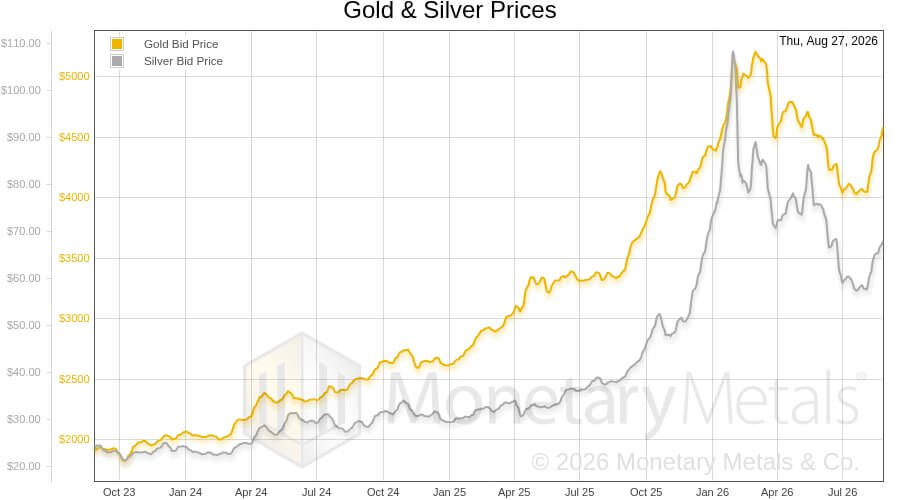
The gold price rose approximately 67% in 2025 [3] and continued to set records in early 2026, with the LBMA Gold Price reaching $5,405 per ounce in January[4]. Although prices subsequently retreated, gold remains substantially more valuable than it was just a few years ago.
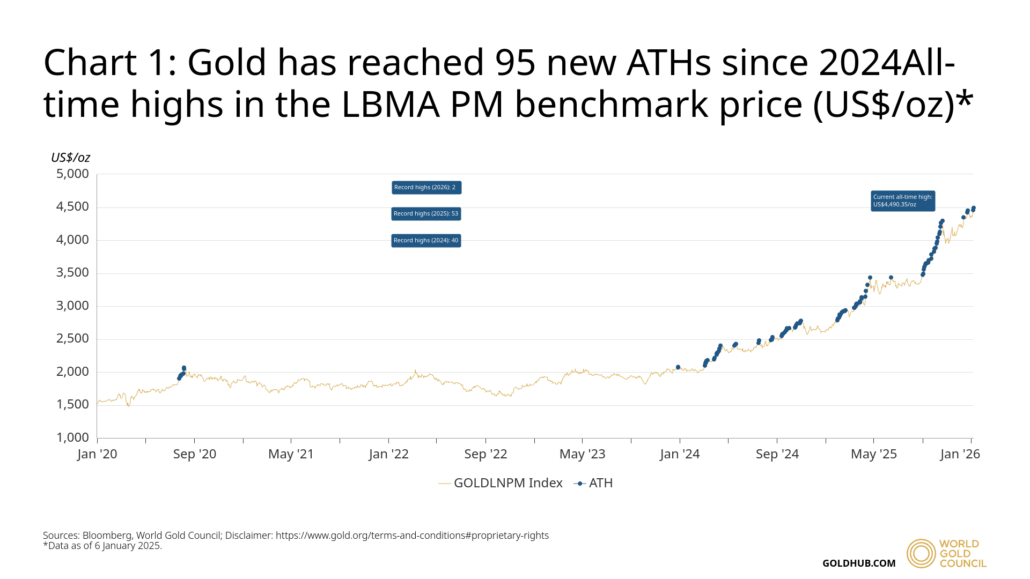
For long-term gold owners paying percentage-based storage fees, this creates a counterintuitive consequence: the more successful your investment becomes, the more you pay to store the same number of ounces.
How storage fees can reduce your gold holdings
The effect becomes more tangible when you pay storage fees from the metal itself rather than from a separate cash balance.
We’ve seen this firsthand with clients who came to Monetary Metals after experiencing rising storage costs. Here’s a paraphrased excerpt from one such client email (shared with permission):
Gold’s up 30% this year. That’s the good news. The bad news? My storage fees jumped, and my vault just sold a small amount of my metal to cover the bill. Now I own less gold than I did at the start of the year.
Methods for collecting storage fees vary by provider. Goldmoney, for example, allows clients to pay storage fees from either a currency or metal balance. Its default method deducts the fee directly from the client’s metal balance[5].
If you pay custody costs from your gold holdings, this introduces another consideration. The dollar value of your portfolio may rise while the quantity of the gold you own declines.
Over a sufficiently long holding period, recurring fees can therefore affect the number of ounces you own.
Lose ounces to store gold, or earn ounces to lease it?
If you intend to own gold over the long term, there’s another way to evaluate the economics of holding physical metal: instead of paying an ongoing fee to store gold, you could generate a return on your metal.
How?
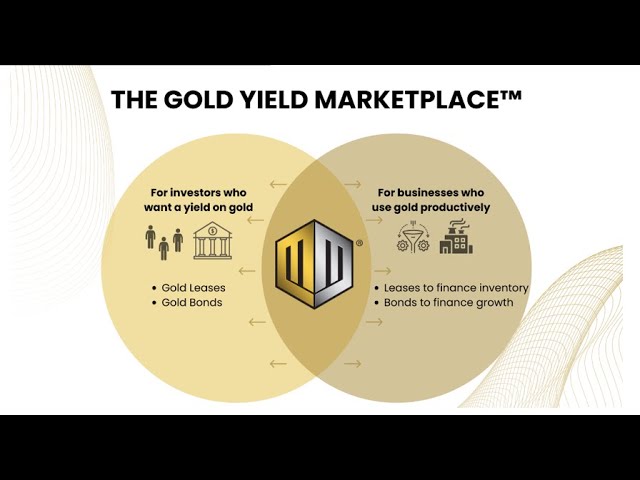
Gold leasing enables gold owners to make their metal available to businesses that use gold as part of their operations.
Refiners, mints, jewelers, and other gold-using businesses can lease metal rather than purchasing all of the inventory they require outright. In return, the gold owner earns a lease yield.
Explore our Funded deals for examples of businesses that use leased gold.
At Monetary Metals, lease yields are paid in gold.
This means the return is measured in additional ounces rather than depending solely on an increase in the dollar price of the metal.
Through the Gold Yield Marketplace®, you can hold gold without storage fees or make eligible gold available for lease to earn a yield.
Instead of recurring storage costs gradually reducing the amount of gold you own, a successful lease has the opposite effect: you earn additional gold.
Can you put gold to work without sacrificing security?
Putting gold to productive use introduces considerations that don’t exist when metal remains stationary inside a vault. That’s why the structure and security of a gold lease matter.
At Monetary Metals, we protect client gold and silver through multiple layers of security, including:
- Comprehensive, robust insurance coverage
- 24/7 RFID monitoring of leased gold
- Personal and/or corporate guarantees from gold-using businesses
- Audited reports and independent verification

And you’re not required to lease your entire holding. You can choose to make a portion of eligible gold available for lease while retaining the remainder in storage.
While your gold is held in a Monetary Metals account, you don’t pay storage fees and you may even earn a 1.5% yield on your metal, even when it isn’t leased.
Don’t get penalized from a rising gold price
The economics of owning gold shouldn’t become less favorable just because your metal becomes more valuable.
At Monetary Metals, you can hold gold without storage fees or put eligible ounces to work through a gold lease. Either way, a higher gold price doesn’t result in a higher storage bill.
For long-term gold owners, that means appreciation can remain something to welcome rather than another expense to manage.
But eliminating storage fees is only one way to reconsider the economics of gold ownership.
Discover a new way to hold gold.
Sources:
- https://www.goldmoney.com/docs/goldmoney-fees.pdf
- https://www.bullionvault.com/help/tariff.html#Custody%20charges
- https://www.gold.org/goldhub/research/gold-demand-trends/gold-demand-trends-full-year-2025
- https://www.gold.org/goldhub/research/gold-mid-year-outlook-2026
- https://support.goldmoney.com/hc/en-us/articles/39900565519259-Storage-fee-payment